
On her deathbed, Gertrude Stein asked, “What is the answer?” After a moment she asked, “What is the question?”
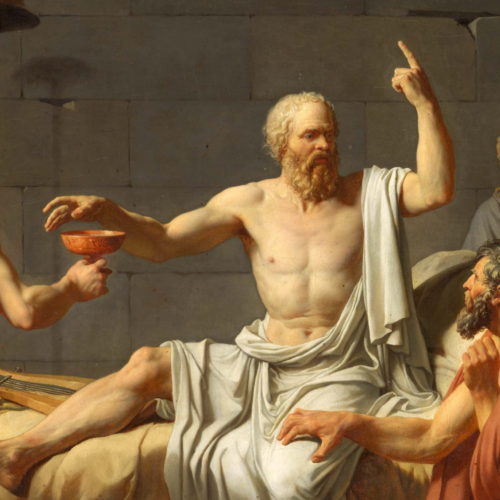
469-399 BCE
Socrates, who was known for his ability to use questions to arrive at truth, suggested questions are like a midwife delivering a baby: questions give birth to truth.
One way to tell the story of God is by tracing the questions found in the Bible. A couple of summers ago, I went through the Bible and wrote down the questions I encountered.
From Genesis-Deuteronomy:
- Did God really say “You must not eat from any tree in the garden?”
- Where are you?
- What have you done?
- Am I my brother’s keeper?
- Can a son be born to a 100-year-old man and a 90-year-old woman?
- Is anything too hard for me?
- Where is the lamb for the sacrifice?
- What shall I tell the Egyptians your name is?
- Why did you bring us here?
- Why do you put the Lord to the test?
Here are three things I learned from looking at this section’s questions:
- In Genesis, the most frequent question is: “What have you done?”
- Moses asks God questions out of insecurity and fear and God strengthens him. When Israel asks Moses questions for the same reasons, Moses tries to model God in his response.
- God uses questions just like Socrates: they help birth truth.

Here are questions from Joshua through Esther:
- Have I not commanded you to be strong and courageous?
- What do these stones mean?
- Has not the Lord gone ahead of you?
- Why have I found such favor in your eyes that you notice me—a foreigner?
- What did God say to you?
- Why did you not obey the Lord?
- Where shall I go now?
- What do you want me to give you?
- How long will you waver between two opinions?
- How can there be peace as long as all this idolatry and witchcraft abound?
- And who knows but that you have come to royal position for such a time as this?
One lesson learned from these questions:
God’s biggest struggle with his people centers around loyalty and trust. Has that changed?
Here are questions from further into the Hebrew Bible:
- Shall we accept good from God and not trouble?
- Where were you when God laid the foundations of the world?
- Why do the nations rage?
- What do I long for?
- Where can I go to flee from Your presence?
- Of what use is money in the hand of a fool?
- What do people gain from their toil?
- Who can tell the future?
- What does the Lord require of you?

Turning to the New Testament, here are some questions people asked Jesus:
- Who are you?
- What is the greatest commandment?
- What must I do to inherit eternal life?
- Where can I get this living water?
- What Is truth?
And these are questions Jesus asked:
- If you love only those who love you, what reward should you get?
- Who of you by worrying can add a single hour to your life?
- Who do you say that I am?
- What do you want me to do for you?
- When the Son of Man returns, will he find faith upon the earth?
- Do I offend you?
- Why are you so afraid?
- Do you want to be healed?
- What will it profit them to gain the whole world and forfeit their life?
Frederick Buechner said:
We are so much involved with questions about things that matter a good deal today but will be forgotten by this time tomorrow—the immediate wheres and whens and hows that face us daily at home and at work. At the same time we tend to lose track of the questions about things that matter always, life-and-death questions about meaning, purpose, and value. To lose track of the important questions is to risk losing track of who we really are and where we are really going.
The Bible contains THE questions that are central to our relationship with God. As I pored over these questions, I found the questions Jesus asks are weightiest. They are about our welfare, not his. Three, particularly, that stand out for me are:
Who do you say that I am?
That is the question I have to answer before my life makes sense. If I respond: “You are my Savior and Lord,” as I have been taught since I first began learning God’s story, then my life needs to support my answer. Saying Jesus is Savior means acknowledging that I need rescuing—mainly from myself. Saying he is Lord means that I must live my life giving him control.
I confess I have not always been very successful at those things.
The second question that troubles me is “Do I offend you?”
Jesus was offensive. He was, at times, a fanatic who asked his disciples to leave their families to follow him, who told the religious authorities they reminded him of whitewashed tombs, who told people they couldn’t love God and money, and who told them to take the lowest place. He said that at the final judgment, he would say to some: ”I do not know you.” How do we get our heads around such things?
The third question that increasingly haunts me is: “But when the Son of Man returns, will he find faith upon the earth?”
Evangelism is a loaded subject. We live in a world where Christians are sometimes scorned and labeled “intolerant” and “misguided.” We have probably brought this upon ourselves by preaching the gospel in a self-righteous, dogmatic manner. But like Jesus, the gospel can be offensive. And yet we don’t want to offend. The temptation is to water down Jesus’ strong language and hide from his hard questions. Do we, to quote T.S. Eliot, “dare disturb the universe” on his behalf? If we do not, will there be faith upon the earth when Jesus returns?
Scripture invites us to wrestle with hard questions, questions about who our neighbors are, what truth is, who God is, and what God requires of us. A life of allowing the Bible’s questions to challenge us will bring us, finally, to ask with the psalmist: “Whom have I in heaven but you?”

14 Responses
Marvelous.
Nancy, a few years back I facilitated the ESL Bible study group through some of the questions God asks us and we ask God. It was a rich time together. Your essay this morning tells me that we could easily expand and be challenged again. Thank you.
Very thought-provoking. If I may compliment you, I would say you ask very good questions, lots of them! Questions often lead to deeper truth. Answers often put a cap on truth.
There is always another, then another question behind the question: “Where are you?” Eve and Adam, probably means , “Why do you, all of a sudden, feel a need to hide from me?” And, “Have I offended you?” could mean, “Have you thought about why you are offended?”
Questions are usually far more effective than declarations, defensive as we tend to be. When God is rhetorical, it is always justified. God’s motivation is predominantly self-sacrificial. God is inviting us into decision-making fellowship. And God seems to prefer listening to lecturing. “Come now, let us reason together.”
I need to be careful with my own (presumptuous) motivation, lest it become a self-righteous judgment.
I enjoyed reading this. It is devotional as much as intellectual.
Thanks, Nancy, deep thanks for this piece. And my thanks to God, both for your gifts and for your using them faithfully to bless many. Among them, me.
This is so beautiful and thought-provoking.
Nancy. I loved this. Thank you for writing.
Hi Nancy: This is really great. I’ve also found that when Jesus was questioned, he often responded not so much with answers as with commands, counter-questions, rebukes and stories. He wasn’t like a slick politician trying to be evasive so that we’d still vote for him, or a philosopher who thinks there are no answers, but he was trying to get his questioners to face the hidden agendas lurking behind their questions.
Thank you Nancy, thought provoking words as always from you. I remember when we were at Creston and pastor Lew told our students in an assembly “If someone tells you to stop asking questions, that is from the devil,” and I remember “Who do you say I am?” on our friend Laura’s classroom wall. Thank you for continuing to be a Truth Teller for us all. Blessings
Wow! What a thought provoking article! Thank you!
When I lie in bed at night wondering where the Spirit is in my life, the answer is: “Where can I go to flee from His presence?”
Thank you for this. I wonder why I have more questionable than answers!
I am both convinced and convicted that the most essential aspect of pastoral listening is the skilled application of questions.
Nancy, when we were colleagues at GR Christian High, I was honored to teach your Bible classes for a semester. I believe I learned as much as the students about asking good questions. Your curriculum was a joy to teach—and I have kept the notebook for reference all these years. You have blessed us all. Linda
Powerful questions and reflections.
Thank you for sharing this with all of us.
Thank you Nancy for this…profound and thoughtful!