
I am nothing if not a pragmatist—I always care about proceeding grounded in principle, of course, but I mostly want to know how (and by whom) the necessary work will get done. How will something happen in actual time with actual people? Perhaps that’s somewhat ironic for someone who has spent her life with metaphors. But perhaps not: metaphors work best, I think, when they move away from abstraction and towards something embodied. But that’s often not the case, especially when we think theologically. In “On Belief in the Physical Resurrection of Jesus,” the poet Denise Levertov wondered about this disconnection, when she asks:
Are some intricate minds
nourished on concept,
as epiphytes flourish
high in the canopy?
Can they
subsist on the light,
on the half
of metaphor that’s not
grounded in dust, grit,
heavy
carnal clay?
Do signs contain and utter,
for them
all the reality
that they need? Resurrection, for them,
an internal power, but not
a matter of flesh?
Instead, Levertov goes on to argue that the “symbol’s power” only works with “its roots in bone and blood”:
We must feel
the pulse in the wound
to believe
that ‘with God
all things
are possible,’
taste
bread at Emmaus
that warm hands
broke and blessed.
Put another way, as Marianne Moore famously observed, the best imaginings are those that feature “real toads in imaginary gardens.”
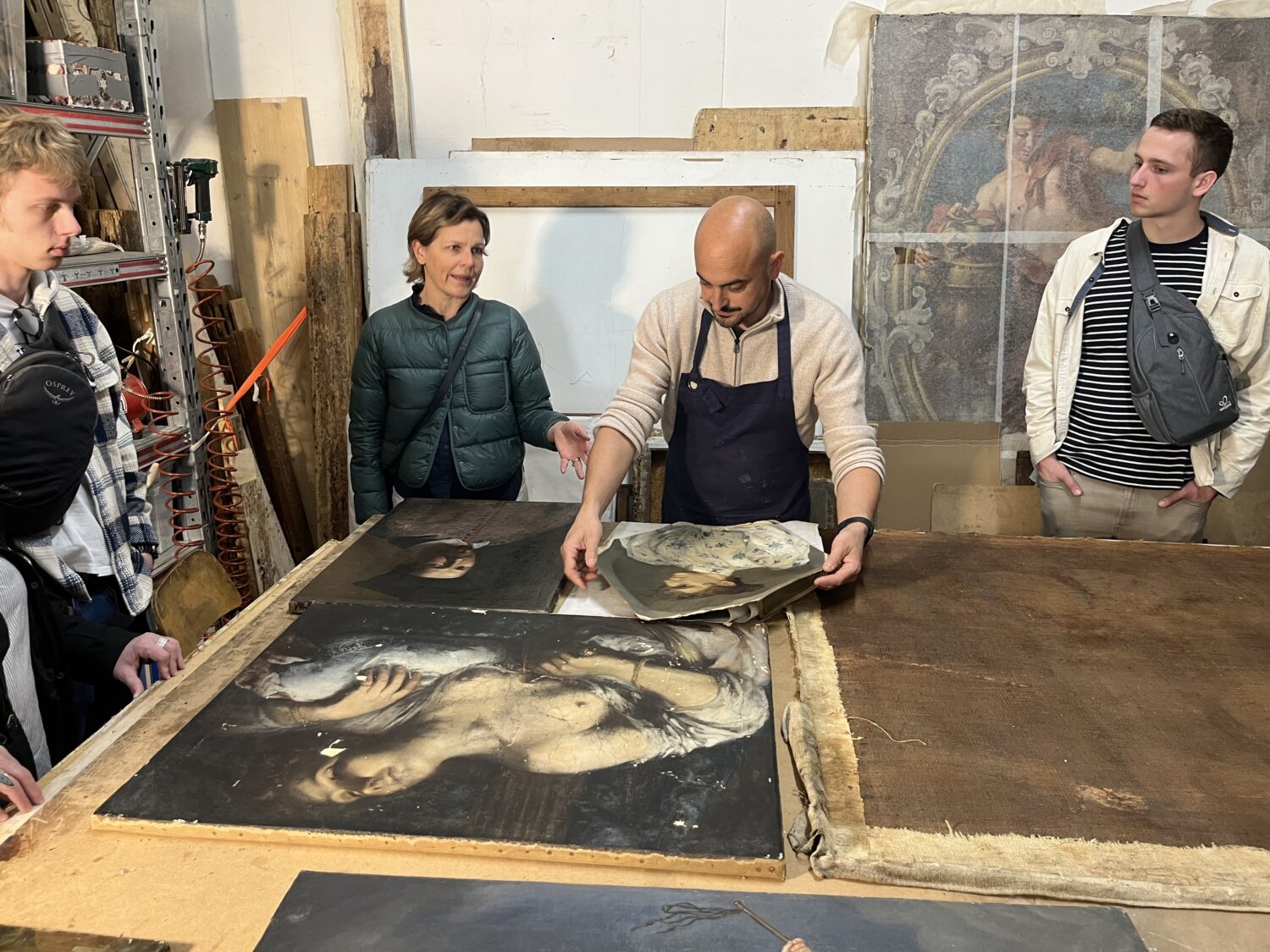
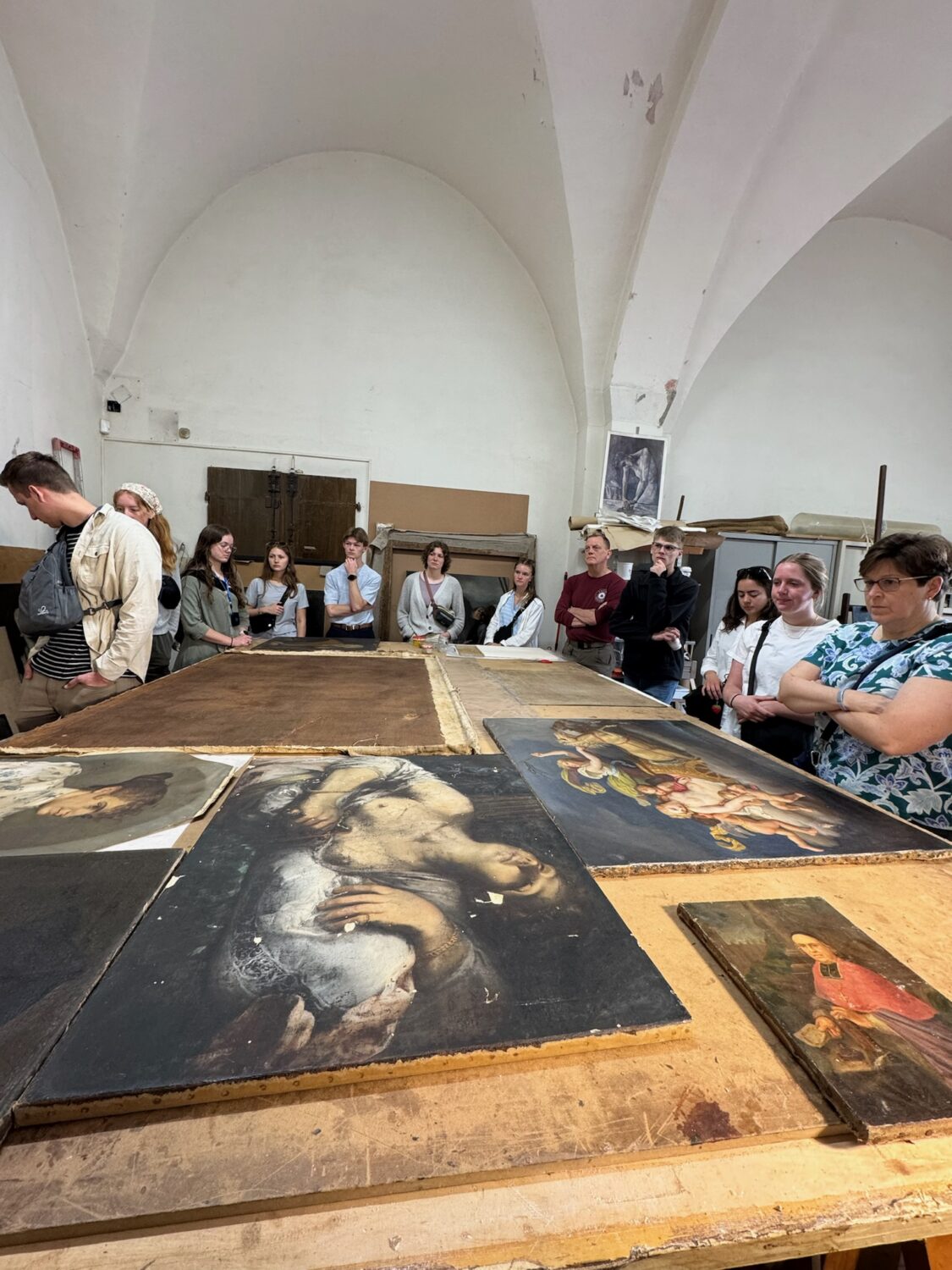
It was real delight for me, then, to deepen my understanding of one popular Christian metaphor on my May trip to Florence, Italy. As I’ve written about in this space before, I teach a two-course sequence on Dante’s Divine Comedy every other spring, and in the May term portion, we focus on our own pilgrimages and the spiritual practices that we need for that expedition. (In fact, each student selects three practices to focus on throughout our weeks together). In addition to visiting galleries, museums, and churches, we also work on embodiment: we worship, pray, hike, sing, eat together. And this time, we took a cooking class and got to visit an art restoration studio. Our guide, the wonderful Christiane, is a trained art conservator in addition to her guiding gig, and originally, I had asked her to explain her work to our class. When I arrived in Florence, however, she let me know that she had asked the head of her studio, Lorenzo, to talk with us instead. Turns out, Lorenzo is a world-renowned expert in canvases and participated in the much-publicized recent repair of a newly found Caravaggio! Graciously, he invited us into the workshop and spent the morning with us, describing all that restoration requires.
Christians rightly love the idea of “restoration,” don’t we? Not just for ourselves, but, as my university proclaims in our mission statement, the way that we participate in restoration as “agents of renewal.” In many ways, the very existence the profession of art restoration testifies to primary theological truths: that though damaged, the original creation was good and worthy of being lovingly rescued and reconditioned. After all, God isn’t in the business of starting over from scratch.
Seeing how that happens made me love “restoration” even more and provided some key takeaways:
- Understand the damage
Lorenzo began by gathering us around a large table that held several very old paintings. One painting dated from 1602—and surprisingly, he urged us to pass it around and touch it. As you can imagine, we were quite hesitant to do so. But he was asking us to understand exactly what the damage was—which could only be appreciated by direct engagement, not only with our eyes but tactilely. As we all know, sometimes things can look better than they are. Better to name the problems.
2. Understand the aim of the work
As the name implies, conservators do not work to change the painting, but to support it (quite literally so that it does not disintegrate), to repair the damage that has occurred at some earlier point in its life, and to ensure its longevity as the best version of itself. What would that mean if we took that to be our objective? Unpacking that part of the metaphor seems like a whole sermon right there.
3. Understand the canvas
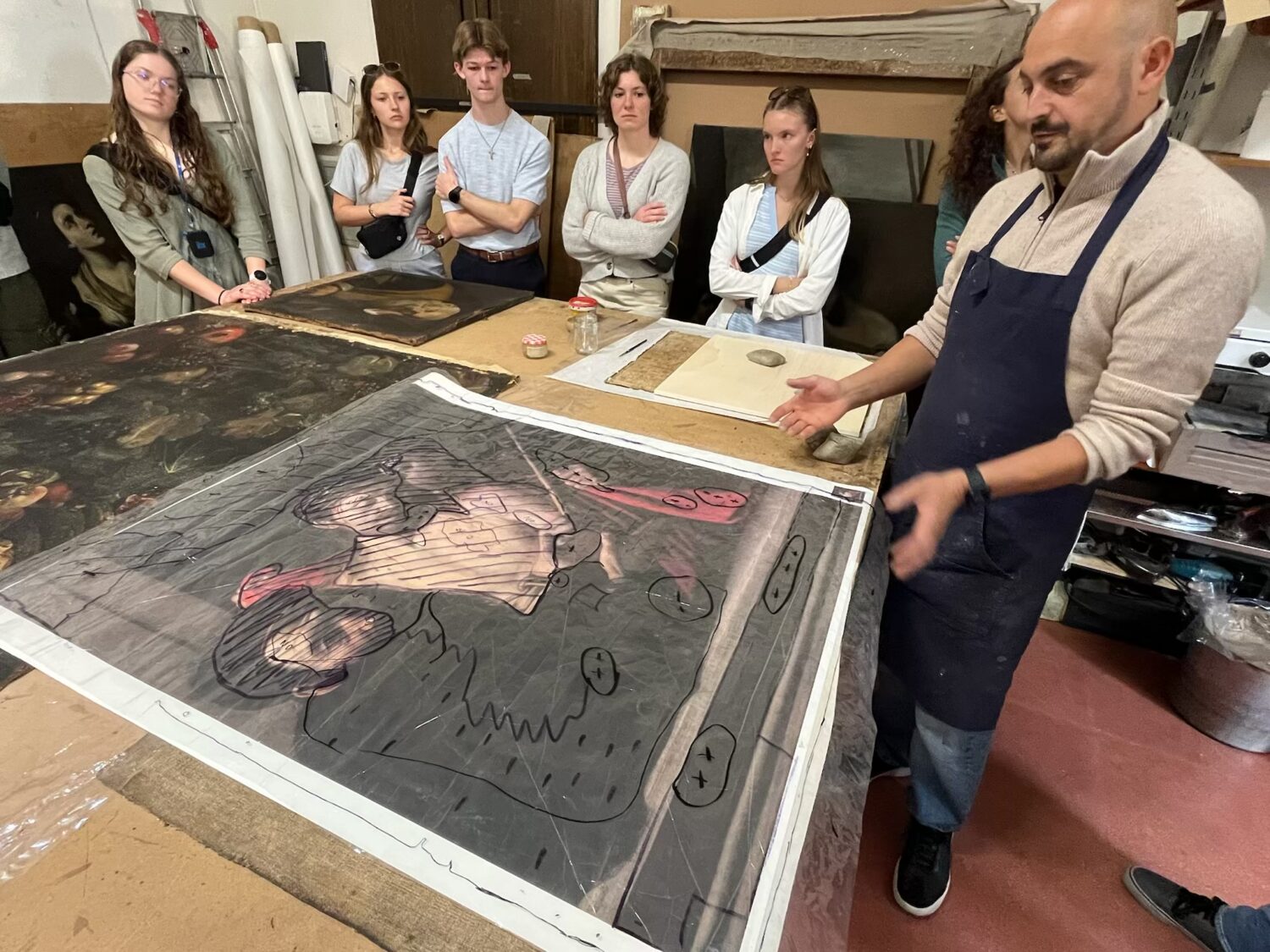
My mother often observed, “you’ve got to know what you’re working with.” I was surprised to learn how much a canvas moves. I think I’d always assumed that as an inanimate object, paintings were static in their frames. Not so much. It turns out, because of that movement, restorers can’t just easily slap a new backing on an old work. Such a move can destroy the painting, rather than preserve it. Instead, there’s an entire process to preparing a new backing support that will truly serve the canvas that is being conserved. How can we become more astute about what is needed by the “canvases” we’re working on and with?
4. Understand the craft
Lorenzo’s presentation of the many steps required in this process was a necessary reminder that it is a process. Of course, it takes lots and lots of time because the work is painstaking: he works on canvases strand by strand, a millimeter at a time. And with a lot of ordinary tools and materials, such as so-called “Pasta Fiorentina,” a glue made of flours and animal bones and other substances that he mixes himself in his studio. Even though the end result is beautiful, it’s not very glamorous getting there. And I find that a great comfort.
5. Understand your role
Maybe because of the portrayal of art conservation in the movies, I hadn’t ever given much thought to the way in which high-level art restoration is so incredibly specialized. I realize that that seems obvious, but I think I had assumed that, though they might have assistance, people were mostly in charge of a painting from start to finish. Not so. I must say, though, that I find that fact quite cheering: in the grand work of Christian restoration, there will be parts of it that I’m quite good at and can contribute, but because I work with a team of other experts, I don’t have to do it all. Amen and amen. What is mine to do?
6. Understand the timeline
We learned on that early May morning that works must be actively conserved—canvases wear out, glues begin to loosen, paint fades and cracks. No repair is forever. And that’s okay—in our lives, it’s that final gorgeous restoration that we’re aiming for.
In the meantime, Paul’s words in 2 Corinthians 4:16 remind us to understand the sure hope of the process: “Therefore we do not lose heart. Though outwardly we are wasting away, yet inwardly we are being renewed day by day.” Thanks be to God.

7 Responses
Wow! How lucky your students are to have you as a teacher and guide.
This comparison of the Christian life to the restoration of art canvases is beautiful and give me hope, too.
What a fantastic opportunity, as close as you can get to visiting a 17th or 18th C artist at work on a painting! Thanks for letting us look over your shoulders.
Thanks, Jennifer. I especially liked the part about how the canvas is always moving. That reminds me of how God does restoring work on us, even though we’re constantly moving ourselves. One hour we’re kind of touchy or hyper, the next we’re bored or sleepy. Never a static moment in the work of restoration, I guess. Reminds me of giving a child a haircut and I constantly have to tell them to sit still.
A fresh, enlightening, memorable metaphor. Thank you.
Jennifer, thanks for making us mindful of our personal restoration journey.
Jennifer,
I was immediately on guard against Levertov’s “On Belief in the Physical Resurrection of Jesus.
Because his resurrection was not merely physical. His body was not merely resuscitated.
He became the first fruits of what Paul calls the “spiritual body,” the foretaste of the New Creation in his person, able to make believers into New Creatures, “restored” in his likeness, harvest hands in the New Eden he is even now restoring.
Otherwise, thank you for this essay and all its ramifications.