
Most people have heard of Charles Darwin’s voyage on the HMS Beagle. Some may know of Alfred Russel Wallace’s travels through the Malay Archipelago or the oceanographic expeditions of Sir Charles Wyville Thomson on the Challenger. Far fewer have heard of the voyage of the Sorcerer II.
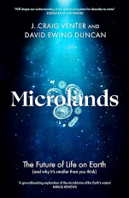
That is understandable. Unlike the famous scientific expeditions of the nineteenth century, which collected birds, insects and other visible specimens, the Sorcerer II set out to collect something much smaller: microorganisms. Its journey is the subject of Microlands: The Future of Life on Earth (and why it’s smaller than you think) by scientist J. Craig Venter and science writer David Ewing Duncan.
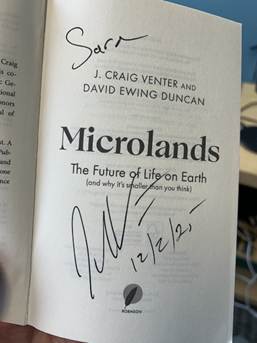
My copy, autographed by Venter, was a Christmas gift from my scientist son, Joseph, who heard him speak late last year. Sadly, this was probably Venter’s last public lecture as he was diagnosed with prostate cancer recurrence shortly afterwards and died of unexpected complications of his treatment on April 29, 2026, at the age of seventy-nine.
Craig Venter was one of the most consequential—and controversial—scientists of his generation.
After graduating from high school, he joined the Navy Medical Corps and served in Vietnam. Before he was deployed, he worked in the infectious disease unit of the Naval Medical Center. He saw and treated soldiers, returning from Vietnam, with a variety of infectious diseases—malaria, cholera, tuberculosis. Venter’s first-hand experience with these diseases shaped his interest in microbes and human health.
After earning degrees in biochemistry, physiology and pharmacology he entered academia and eventually did research at the National Institutes of Health (NIH).
While at the NIH, Venter became frustrated with the traditional methods used to identify genes. That frustration fueled his quest for alternative methods of genetic analysis and his move into the private sector where his career was defined by bold ideas and technical innovation. He helped sequence the first complete genome of a free-living organism, pioneered new methods of genome sequencing, and became a central figure in the race to sequence the human genome. His new approach to sequencing, whole genome shotgun sequencing, breaks a large genome into many small, overlapping pieces which are sequenced, and then overlaps in those sequences are used to reconstruct the full-length genome sequence.
Venter went on to help launch the field of synthetic biology by creating and transplanting synthetic bacterial genomes.
Venter’s achievements were extraordinary, though his confidence and ambition also attracted criticism. Full disclosure: I’m something of a Venter fan. I admire his brilliance, word ethic, vision, and willingness to challenge scientific paradigms. That admiration undoubtedly colors my reading of this book.
Microlands chronicles what became Venter’s last grand scientific experiment: a trip around the globe to collect seawater samples and catalog the microscopic life they contained. The research team pushed 200-gallon samples of seawater through progressively smaller filters and sent those filters back to labs for whole genome shotgun sequencing with mixed samples.
The scientific rationale for their idea is the subject of the first part of the book. Venter and Duncan help the reader understand how advances in shotgun sequencing make it possible to analyze whole communities of microorganisms rather than culturing each one in the lab and analyzing each individually. Their pilot project in the Sargasso Sea demonstrated, not only that their sequencing approach could work, but that the oceans contained far more microbial diversity than scientists previously imagined. The authors make a compelling case that understanding this hidden world is essential to understanding all life on Earth.
The middle section reads as a travel narrative. The team encountered storms, equipment failures, bureaucratic obstacles, and accusations of “biopiracy” from some nations that controlled the waters where samples were collected. Although I found this section less engaging than the scientific portions, it does provide a vivid picture of how difficult global scientific research can be.
The book’s final section reports what scientists have learned from the expedition so far. The overwhelming conclusion is diversity diversity diversity!
As a Christian and a scientist, I did not find this diversity surprising. Instead, I found it deeply affirming. The microbial world reveals a Creation marked by extravagance, creativity, and interconnectedness. Venter and Duncan repeatedly emphasize how all life is connected—a conclusion that resonates with my Christian understanding of God’s Creation as an ordered and independent whole.
Venter and Duncan also argue that this knowledge should inspire greater environmental stewardship. They warn about pollution, habitat destruction, and climate change while offering hope that some of the solutions may come from the microbial world itself. Hidden among these vast and diverse microbial communities may be organisms capable of helping us address environmental problems of our own making.
The scientific legacy of the voyage is already substantial. Data from the expedition have generated numerous publications, and Venter’s institute has created a public database, CAMERA, where information about microbial biodiversity can be shared.
Although Venter is gone, his work continues. The microbial world he helped uncover remains largely unexplored. Most samples still need to be sequenced and analyzed. The data that emerge from this grand experiment will certainly lead to future discoveries. In that sense, Microlands is more than a travelogue or a scientific memoir. It is an invitation to see creation anew by paying close attention to the vast and diverse worlds that exist at microscopic levels.
6 Responses
Sara, you keep opening our eyes and minds to see an amazing creation and an amazing Creator! Thank you.
Just when we think we know it all, along comes an amazing discovery. Thank you for sharing this, engaging even those of us who are not very scientific, although it does give one pause when thinking about going into the ocean.
Sara, thanks so much for writing this and emphasizing the diversity of our ecosystem. I wish the Christian community would acknowledge the fragility of that ecosystem, as well as its complexity.
On a bit of a side note, I am less of a Ventnor fan than you are. While I too have experienced the restrictions of the scientific regulatory bureaucracy in my career, I think it is a mistake to let the wealthy and well-connected decide what science is important and who should benefit. The scientific enterprise in the United States was exceedingly productive and innovative from 1950 until about 2015 in large part because it was designed to allow all ideas to percolate upwards and let the better ones survive.
Thanks for this! What you refer to as even more “extravagance, creativity, and interconnectedness” challenge us now and also await us on the New Earth, where we will have plenty of time to study and appreciate it.
Thanks, Sara. In my senior seminar entitled “Science, Anti-Science and the Christian Faith,” we read Francis Collins’ book “The Road to Wisdom.” (He also makes a remote appearance in our class, thanks to Jill’s connection to him at UMICH.) In his book, he speaks about the healthy competition between the HGP and Ventner’s Celera. Collins was proud that both he as director of HGP and Ventner were both present at the event that you linked in this essay.
Not to disregard Darwin and Wallace, but Georg Steller accompanying explorer Vitus Bering in the century previous, observed, identified, and gave his name to many northern species—including the Steller Jay seen from the Pacific Northwest of North America to the Rockies