
A faint rainbow on the eastern horizon and while there may be rain over there, there’s none right here. I am angling home under the heat dome and I route myself past the hill prairie, the holiest spot in my world. A few days ago, I spotted a deer there. Half a mile off. Her summer-red coat standing proud against the rowdy afternoon tallgrass and prairie dock. Two beers and a walleye fish fry into my holiday weekend, I wonder if a rainbow can bleed itself out of the saturated air without needing that air to condense itself into actual rain.
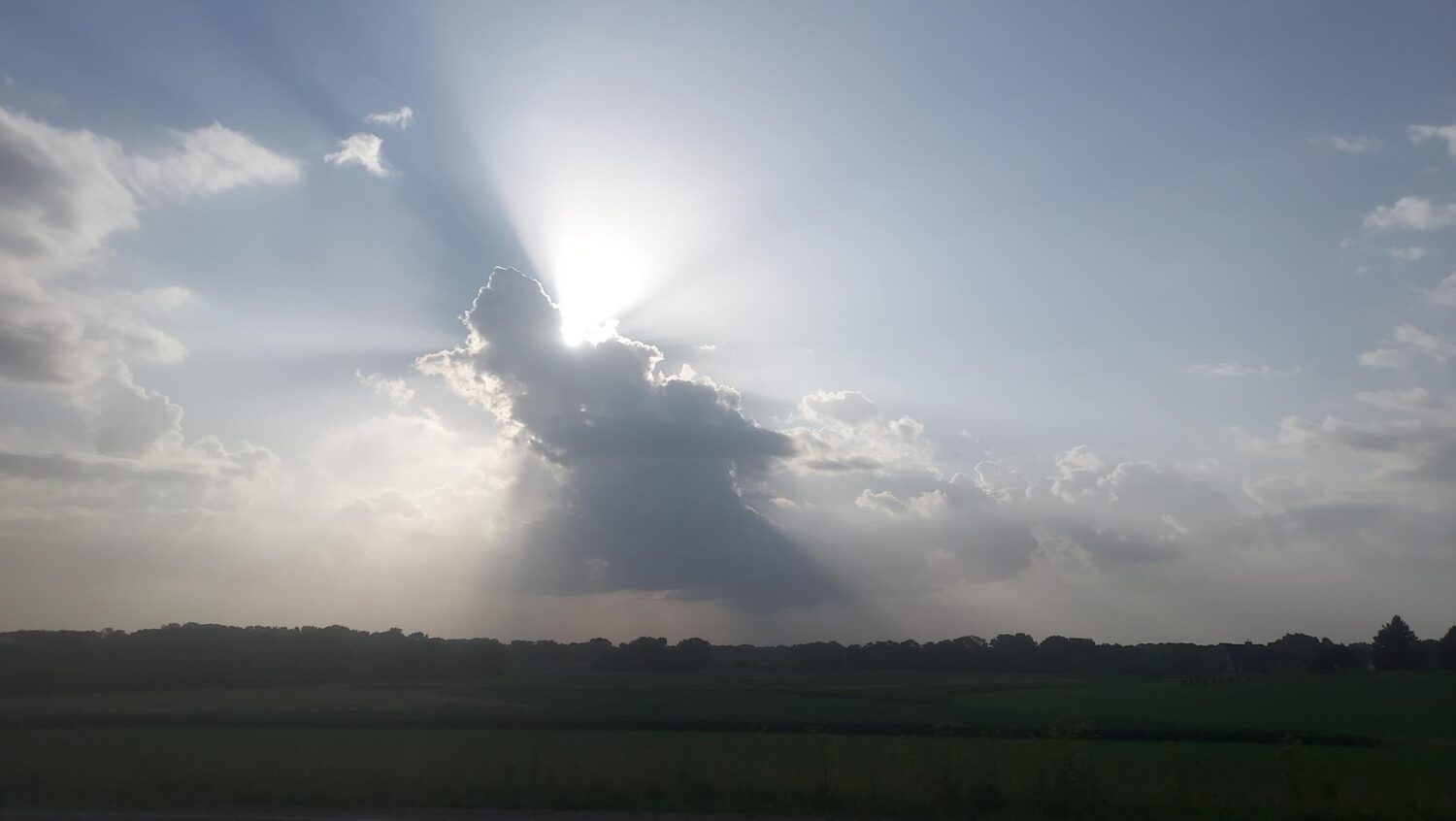
High summer and the plant life here in the muggy Midwest is pumping with all abandon, turning sunlight, soil minerals, and atmosphere into plant tissues, gassing out oxygen and water vapor with all urgency. Lichens bloom on the moldering woodpile – what’s left of the mountain ash, a boreal expat that suffered the summer heat with us before giving in to a fungus.
It’s been blowing hard out of the southwest for days, pushing the hot breath of the prairies here into the Great Lakes region. Except the prairies aren’t really prairies anymore. The agricultural Midwest is a patchwork of homogeneity and uniformity enforced by satellite-guided precision delivery of chemical fertilizers and proprietary seeds.
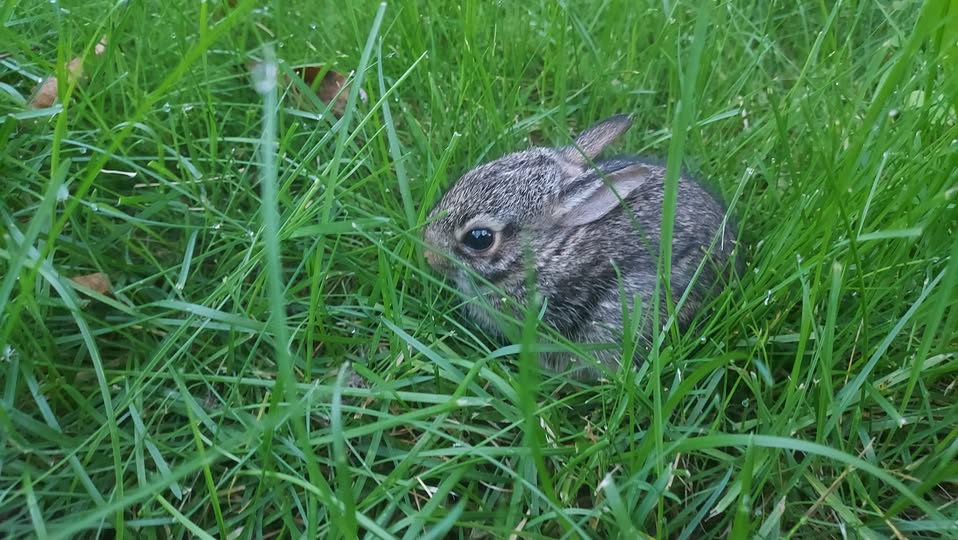
High summer and the animal life is racing to turn the summer plant largesse into animal biomass. I have young of the year (YOY) rabbits in the yard and my trail-cam captures raccoon families and opossums at night, and voles of some sort, and six bats in the sky while the neighbors were setting off fireworks. I had four YOY woodchucks on the woodpile – all on my (and the bank’s) quarter-acre of sleepy suburban bliss.
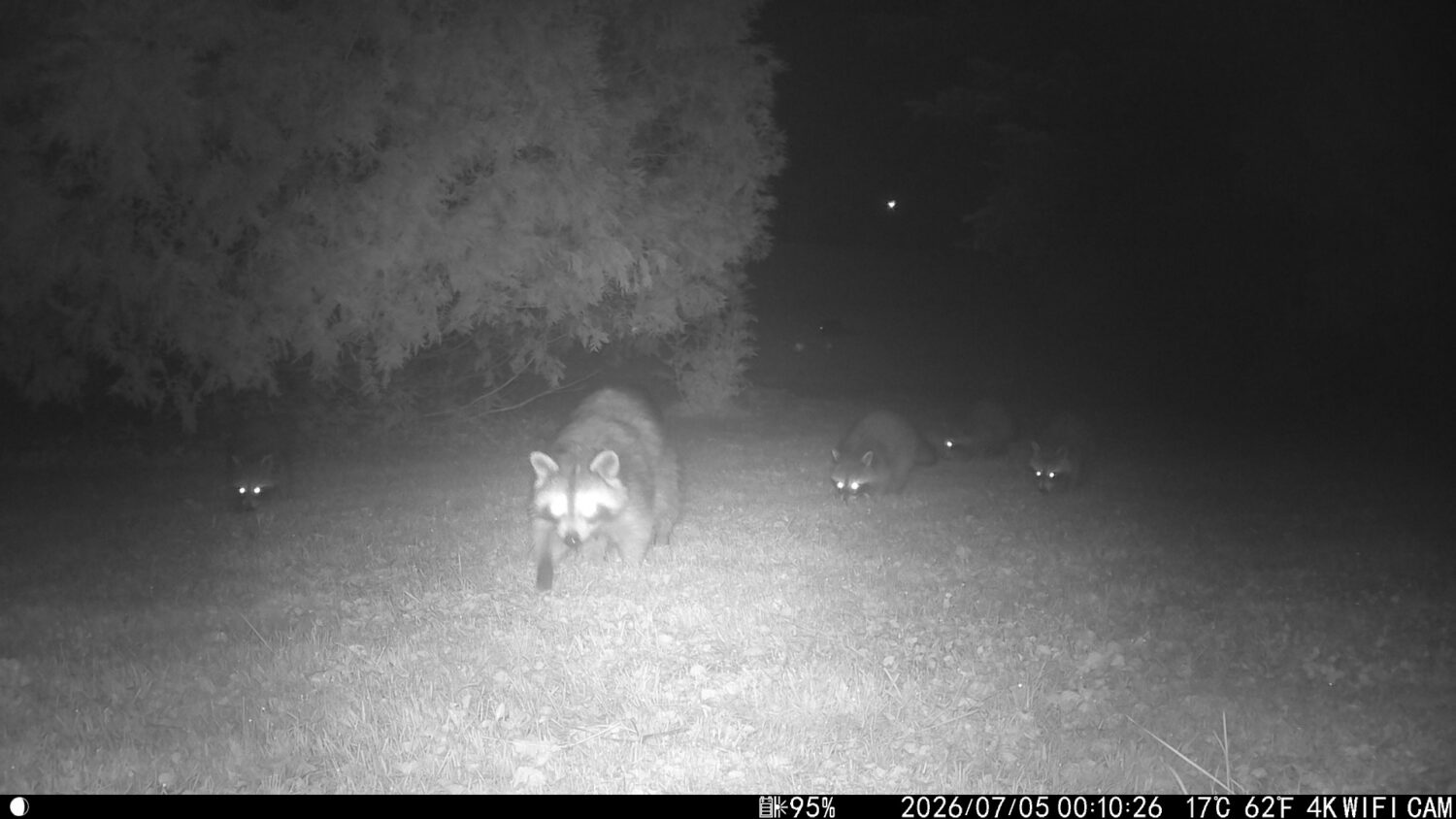
We bought the place from a young couple, one an engineer, and the yard then was neat and trim and tame. Decades later, under the careful neglect of an ecologist, the lawn (loosely defined) blooms with diversity and insects and the cedars are crowding together creating a refuge for shade-loving associates. I am always surprised at the productivity of this little patch – used to be a wetland I’m told but who knows anymore.
Guide me to the margins and among the weeds and wastes. Crawl through the hair at the back of my neck while the sweat beads on my back. I want to linger in the shade and see what I learn. Feed my fever illusions and let me dream a bit – of soft decay and rebirth. They say you can hear the corn grow on nights when the wind’s still. A colleague here in the ag college listens for the corn borers chewing at the roots.
The landscape’s color scheme is chlorophyl concentrate, deep and dark. The strawberries at the Farmer’s Market are transcendent. The cloudscapes too. Sultry, syrupy, silky and warm, the overburdened air sticks on your skin like a wet t-shirt – sometimes literally. I complained about its discomfort to a friend, years ago, when I worked in Illinois. He told me, having grown up in arid west Texas, that he found it soothing. Funny those conversations you remember.
I gambled that I could beat the weather map on the way home yesterday and pedaled into the snarling teeth of an angry thunderstorm where my route crosses through the farm fields with nowhere to seek shelter. I am a Midwest kid, cavalier about thunderstorms, but I don’t remember them like this. Got nearly blown into the ditch. Actually stopped, got off the bike, and hunched over leeward in the gale to protect my face from the abrasive sting of wind-driven rain and catch my breath.
James Bratt’s Friday essay is still scratching around in the crawlspace of my brain (I wish I could write like that) and fireflies returned this week. Those are the only fireworks I have any interest in. A Facebook post said that we’re the last generation to know fireflies. I hope that isn’t true but I haven’t tracked down the veracity of that claim. Even so, I celebrated to see them again. Like James says, on and on it flows and I’m tired and anxious. I’ll wrap the weekend around myself. Burrow in. Make myself invisible with stillness, like the young rabbits. Face myself leeward and wait for the weather to break.
Red Molly is singing “Gulf Coast Highway” in my speakers, a loving and lovely homage to the song’s writer, the peerlessly pure soul, Nanci Griffith. My algorithm is Americana on repeat, a place where myth and brokenness is made beautiful and we sing about it and the last verse is always a redemption – even if tragic. The ditches and the low areas sing too. The landscape wants to be prairie savanna and mesic forest and it keeps trying.
On Sundays I’ve been up work-day early and I take my coffee and binos to the backyard before church. I neglected to take the bird feeders in early enough last spring and a male northern house finch built a nest in one of them. The guidebook says that they build a “messy nest” of sticks – which was certainly true. It looked like a handful of twigs crudely stuffed into the home. A birdie kin, his messy nest, my messy back yard.
But it was enough to attract a mate and sometime in June the chicks were watched. I watched them with my coffee. Both adults flying around my yard catching lacy-winged insects and moths and fat larvae, delivering them into the nest. A week in, I could hear the nestlings buzzing inside. A week later, I saw one stick its head out. I saw an adult catch a moth on the wing.
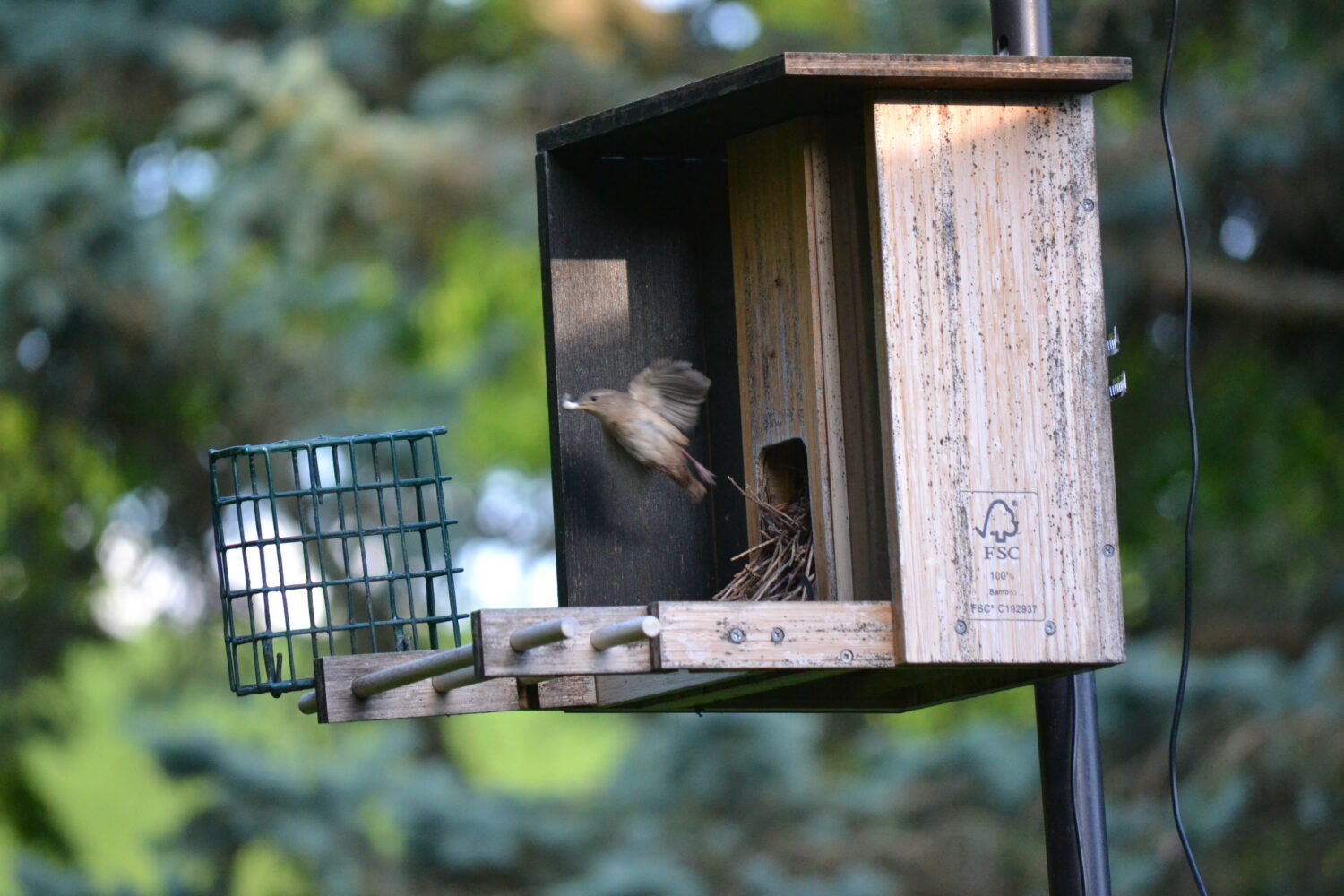
And the parents kept provisioning. Back and forth, chattering directions to one another. For every dozen provisioning bouts, one of the adults would emerge with a white waste pellet and fly off with it. Twice, they appeared to fly up into the spruce and leave the pellet among the upward facing needles.
Why do that? Why use the precious energy when they could just drop the pellets in the lawn? I am behind in all my obligations but my mind makes a priority of watching the wrens. Its just enough, a question just enough to occupy my imagination and displace the mental doom-scrolling. Enough to spin into secondary questions about how do we know? And why? The wren’s mass is roughly that of a quarter. You can imagine how tiny the birdie brain is? Is he an automaton, hard-wired by an evolutionary history far older than mine? A meat-space little robot programmed by natural selection? Western science leads you there. Western scientists (some anyway) wonder if there’s more.
I trip over my own biases sometime.
A friend suggested that removing the nestling’s wastes avoids signaling their presence to potential predators. It’s an ecology-blessed just-so story for why they do that, like so many we tell our students. Makes sense, but I look into my world and want to see resilience in the summer pulse of living things. I want to believe that we’ll make it matter someday. But distinctions about what we know and what we believe have their own messy borders and I go poking around.

14 Responses
My kind of patriotism.
I agree with your assessment of James Bratt but I think the same of you! Thank you for this wonderful start to the day!
So beautifully written and of course the substance is right-on.
James Bratt probably wishes he could write like you!
there may be predator avoidance benefits to taking waste pellets further away from the nest, but chicks have really inefficient digestive systems and the adults often just eat the nutrient-rich waste pellets. Flying away with them might be adaptive, but it could just as easily be that the adults are heading off on another foraging bout and simply eat a turd en route.
Thanks Ryan, very helpful! I think that explanation makes better sense. I’ve been doubting the predator-avoidance explanation because I have doubts about how important a pellet-based olfactory or visual cue might be for likely nest predators when the activity of the adults and, moreso all the noise the nestlings make, advertises their presence. I can also see the energetic benefits for the adults.
Amen!! And SEE like that….
Just write like you, Tim! My interest in science-y or ecology topics is slim at best, but your lyrical and tender prose about the natural world draws me in every time. And then I learn things!
Maybe include a photo of your “messy” yard sometime, Tim?
It’s really us, isn’t it. We are the problem. Look to recent reports from Chernobyl where human absence seems the primary catalyst for recovery from disaster.
I’m not a farmer, but after a summer spent on an Iowa farm, I can confirm that you definitely can hear the corn grow. AI confirms what I heard: “Farmers and researchers describe the sound as a subtle crackling, popping, or clicking — not a continuous hum, but a series of rapid acoustic events.” There is so much that delights us and so much we don’t know. Thanks for describing the wonder of it in this beautiful essay.
Corn also sweats – evapotranspiration, a new word I learned recently, has been active in the past few weeks during very hot weather.😊
Interesting…how the little bird-brained wren knows (instinctively?) how to manage his environment yet we, generally speaking of (supposedly) higher intelligence/instinct have apparently forgotten how to do our part on the same planet.
Thank you Tim and Jim and so many other writers here on RJ that share their gifts and make us think, feel, see, hear expansively.
Your writing is like taking an actual walk in the Garden, which is a balm for the soul in these stressful times. Keep writing just as you have. Thank you.