
“Nightmares are poor dramatists because they have no third act,” says theater critic Max Beerbohm. “They dump you at the climax of terror.”
My small-sample survey suggests nightmares fall into three types: fear of external threats, including enemy accusations; fear of internal inadequacies—mortal if not moral weakness; fear of abandonment. These categories correspond to themes summarized in the opening lines of a melancholic hymn I sang in my natal church:
In the hour of trial, Jesus plead for me.
Lest, by base denial, I depart from thee.
In verse, James Montgomery shows how the three fears are interconnected.
- I am threatened.
- I am not adequate.
- I may be abandoned, which brings me back to danger at a deeper level.
From childhood, I remember two repeating nightmares. The first bespoke external harm. I was alone, outdoors. A buffalo nickel loomed higher than a bedroom ceiling. The disproportional bulk panicked me even before the coin, balanced on its edge, rolled toward me. I ran, never fast enough. I called for help; no one intervened. Just before I was run down, I shook myself awake. I didn’t make sense of this dream until I was an adult: Three weeks before I was born, an older brother was fatally hit by a car. Had my mother’s agony settled into my psyche?
“If we have died with him, we shall also live with him” (2 Timothy 2:11, all RSV).
Pray for us now and at the hour of our death.

The second nightmare was fueled by news reports of Khrushchev pounding his shoe; camp meeting speakers scarred by Stalin’s minions; and two framed pictures hanging in what we called the den (not to be confused with Daniel’s): (1) the ruins of the Colosseum, where lions had mauled martyrs and (2) wide-robed Jesus kneeling against a blood-stained Gethsemane boulder.
The dream cycle was the “hour of trial” dramatically encompassing all three fears. I was in a prison cell, alone among godless Russian men speaking English, torturing me because I would not reject my faith. I hoped there would be enough evidence to convict me. “If we endure, we shall also reign with him” (2 Timothy 2:12a).
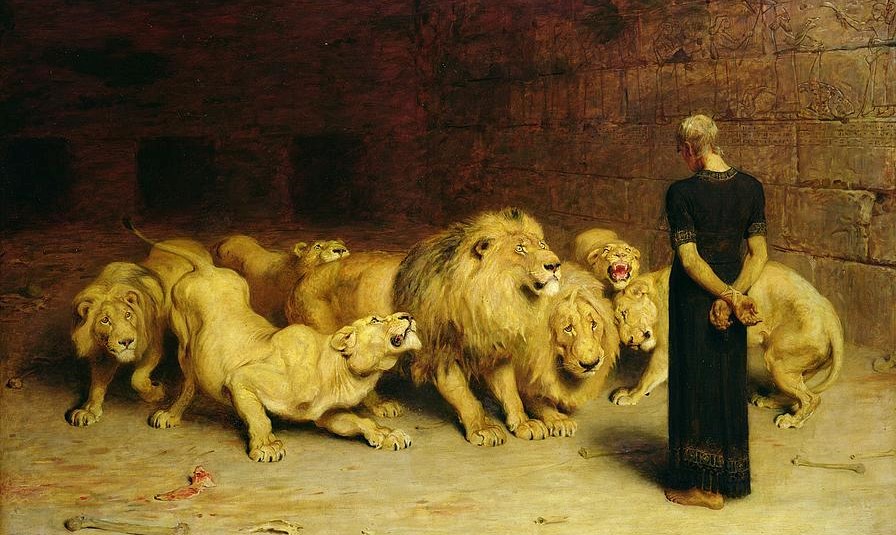
I wanted to “dare to be a Daniel.” But what if I wasn’t strong enough? What if circumstances seemed to conspire against me and I inadvertently denied my Lord? The stakes were so high. “If we deny him, he also will deny us” (2 Timothy 2:12b). If I abandoned, I would be abandoned. I woke up feeling fear, but never regret or remorse for having given in.
Pray for us now and at the hour of our death.
As an adult, my recurring bad dreams—less intense than nightmares—have more often exposed distress over personal weakness. I am not equal to some required task. Many fit the classic high school scenario. I don’t know my locker combination or my class schedule. I’m driving a car I can’t control.

Some bad dreams have betrayed my sense of professional inadequacy. As an editor, my brain is a-jumble, like a jigsaw puzzle dumped on a table, feeling pressure to order the chaos. One night a dreamed client asked me to rework Dr. Zhivago to make it acceptable to an evangelical audience. “But the whole plot revolves around adultery. It’s impossible,” I countered. No one listened. “Just do it. We know you can.”
Another night I was presented with the personage of a bumbling politician. The assignment was vague but the intent clear: “Fix him.” You’re expecting too much. I can’t deliver. I always awake up feeling powerless, exhausted, or inadequate.
Pray for us now and at the hour of our death.
Four months after my mother suffered a debilitating stroke, someone offered me a free and congenial ride from my home in Virginia to my parents’ in western New York. With little personal effort, I could have visited her in a nursing home and cooked my dad a few good meals. But I didn’t go “back home” that weekend, and the decision played itself out in a guilt-filled dream in which I had an abortion, not that there’d been any typical conception. As is often the case, the dream made no sense. This pregnancy had been “induced” antiseptically as a necessary precursor to a hysterectomy. We can perform a hysterectomy only if you’re pregnant. So we’ll artificially implant sperm and . . . then we’ll “take” the baby along with the womb. Yes, okay. I agreed. Proceed.
The dream jumped to a morning-after scene. The “successful” surgery was uneventful. Physically I was immediately recovered, no lingering weakness, no pain. But emotionally I was a wreck: horrified, inconsolable with regret that I had aborted life. I looked for a spiritual confessor who could absorb my remorse and maybe absolve my deadly act, lest I be unforgiven.
Awaking wide-eyed from the dream, I tried to analyze. Aborting life I hadn’t conceived. I tied this to deserting not my Lord but my mother in her vulnerable second childhood. I’d been unfaithful. My human weakness had won out. I, who knew the fear of abandonment, felt like the abandoner. It was a new generation of old dreams, but I hadn’t awakened soon enough to feel fear or powerlessness without the guilt that tied directly back to fear—of my being forever forsaken.
Facing daylight reality, I chose to ground myself in subsequent scriptural sentences written by the older apostle Paul to a young Timothy: “If we are faithless, he remains faithful—for he cannot deny himself” (2 Timothy 2:13).
Pray for us now and at the hour of our death.
“Remind them of this, and charge them before the Lord to avoid disputing about words, which does no good, but only ruins the hearers. Do your best to present yourself to God as one approved, a workman who has no need to be ashamed, rightly handling the word of truth.” (2 Timothy 2:14–15)
Pray for us now and at the hour of our death.
Header photo by Vadim Bogulov on Unsplash
4 Responses
Thanks for sharing, Evelyn. My recurring bad dream is one in which it is five minutes before worship and I have no idea what I will preach about. I am frantically foraging through my Bible, books and periodicals looking for something, anything on some topic or text on which to speak. But nothing. It’s a relief to wake up. My bad dream became reality one Sunday. Five minutes before church I got a phone call that a well-loved young man from the church had died in a car wreck in Europe. I needed to go tell his parents who were already in the pews about it so they could go home and make phone calls. And then I had to lead the service, knowing immediately that what I had prepared was not suitable for the day. I’m glad to report that Jesus was right. In moments like that the Spirit directed me to a text and gave me words.
Yes, the dreams that pursue us and our daily need of grounding. Thanks, Evelyn. Always good to encounter your probing and evocative writerly mind.
Thanks for your great post. To me there is so much to process in so many paths we either acknowledge or deny. Thanks again, very meaningful to me.
As a young parent I dreamed of being in a Dali-esque landscape with my infant and hundreds of other parents. At the advice of unseen “experts” we dismembered our children without question. Thirty years later this dream still haunts me, so I’m especially grateful of your reminder of 2 Timothy 2:13, a true comfort.