
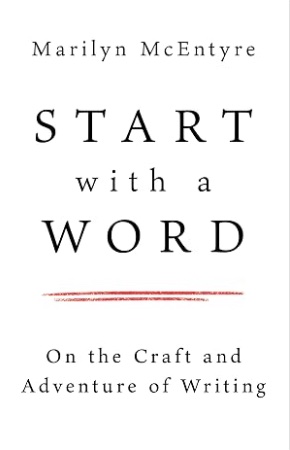
Most books about writing offer rules. Marilyn McEntyre offers something rarer and, I’d argue, more useful: a way of reading. The central move of her new book, Start with a Word, is deceptively simple. She asks us to stop asking what a text says and to start asking how it works. The difference sounds small, but it changes everything. The first question makes us consumers of literature; the second makes us apprentices to it.
Readers of the Reformed Journal will know McEntyre’s name, and many will know her books. Her relationship with Eerdmans now spans nearly two decades and includes Caring for Words in a Culture of Lies — a book I still press into people’s hands — along with What’s in a Phrase?, Word by Word, and Make a List. Across all of them runs a single conviction: that language is a gift held in trust, easily depleted, worth tending. Those earlier books were about the stewardship of words. This one, fittingly, is about the making of them. In many ways, it reads like a culmination.
It also reads like a classroom, and I mean that in the best sense. McEntyre has spent her career teaching — in colleges, seminaries, even medical schools — and she now teaches writing at Western Theological Seminary, where she has been a guiding presence in the “Art of Sacred Writing” Doctor of Ministry program. Anyone who has worked with her, in a classroom or over a manuscript, will recognize the voice in these pages: patient, precise, endlessly encouraging. She does not hand down verdicts. She sits beside you and points at a sentence and asks what it’s doing. The book proceeds the same way: short lessons on the elements of craft, close readings of passages she loves, prompts that invite rather than assign. There are no drills here, no formulas, and (thank God) no promises about your first bestseller.
A glance at the back cover tells you something about her reach. The blurbs run from Richard Rohr to Cornelius Plantinga — which is to say, from a Franciscan contemplative to a Reformed theologian, with Shauna Niequist and Michael Card in between. Not many writers can gather such a diverse congregation. But the breadth makes sense. McEntyre has always treated attention to words as a spiritual practice, and spiritual practices, unlike doctrinal positions, travel well across tribal lines.
Who is this book for? Writers, obviously — beginning ones and, I can testify, experienced ones too. But also preachers, teachers, journal-keepers, and anyone who suspects that reading more attentively might be a form of prayer. In a culture that spends words carelessly and in staggering volume, a book that teaches us to weigh them one at a time is quietly countercultural.
McEntyre has been making that argument, in one form or another, for nearly twenty years. Start with a Word may be her most winsome version of it yet. Start with this one.

2 Responses
Thanks for the recommendation, Doug. This one, right up my alley.
Thank you for your recommendation .Found this site on this very cloudy summers day, and I am grateful.Will buy the books and learn.