
What are we supposed to do when the injustice seems so big and even our best efforts are inevitably too small? When jerking the steering wheel of our own lives does nothing to change the course of the ocean liner we are all on together? When all the guilt I have dutifully stored up in my liberal, well-meaning, middle-aged white lady psyche is not, actually, helping anyone all that much?
I despair, at times, that the only thing left is for it to come out sideways as I Karen* my way through a relatively cushy yoga, coffee shop and pre-school pick-up line life.
According to urbandictionary.com, “Karen” is:
a pejorative term used in the United States and other English-speaking countries for women perceived as entitled or demanding beyond the scope of what is appropriate or necessary. A common stereotype is that of a white woman who uses her privilege to demand her own way at the expense of others.
Common interactions with a Karen* in the wild usually begin with, “Uhm, excuse me?” and end with “Can I speak to your manager?” In addition to “white woman,” other descriptors include “blonde,” “middle-aged” and “middle-class.”
So, basically, “It’s me. Hi. I’m the problem.”
But on a recent research trip to South Africa, I learned about a group of women who have re-oriented my imagination, energized me toward what is possible because, it turns out, hell hath no capacity to irritate like a Karen activated toward justice. Let me introduce you to…
South Africa’s O.G. Karens
On May 19, 1955, Ruth, Elizabeth, Tertia, Helen, Jean, and Jean met for tea in Johannesburg, South Africa. I imagine hats and white gloves doffed at the door, a silver tea service gleaming on the coffee table, chintz upholstery and doilies. Oh my gosh, the doilies! The women’s heels sink into plush carpet, vacuumed in fastidious furrows. With hairdos shellacked and undergarments pinching, these women began smashing tyranny in between dainty bites of cucumber sandwich.
On May 19, 1955 The Women’s Defense of the Constitution League was born. The presenting issue that late fall day in 1955 was new Senate legislation to remove Black voters from the rolls. Their tea party disbursed, phone trees were activated and, soon, 2,000 Karens, each wearing a black sash (mourning the death of constitutional democracy) over their Sunday best, marched in opposition to the proposed legislation.
And that fixed racism.
Well, no. The legislation passed anyway. And once South African Blacks were disenfranchised, the rest of apartheid’s discriminatory system fell easily into place. Pass laws required non-white residents to carry identifying documents at all times. Non-white residents were moved to townships (a sweet colloquialism for tracts of arid, undeveloped land). Carrying one suitcase per household, their houses and all their remaining possessions bulldozed flat behind them, ensuring there was no home to return to.
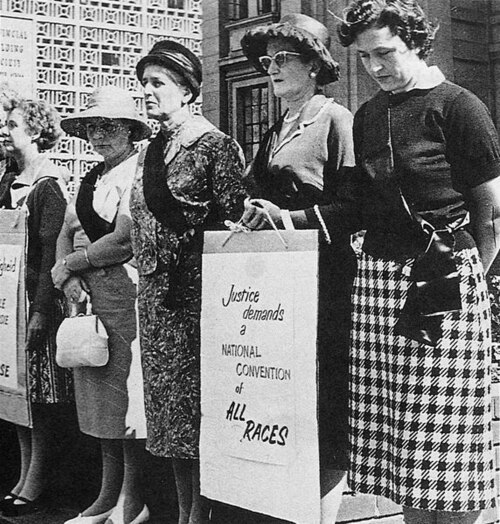
But the Black Sashes (as they came to be known) kept showing up, using “their privilege to demand her own way justice at the expense of others the unjust.”
A bill was debated regarding pass laws. They stood in the galley bearing witness and their eponymous black sashes. The pass law bill got put on hold so the legislators could–real quick–take up a law prohibiting observers in the galley. The Black Sashes showed up in the lobby. So legislators had to call a time out on racism for a hot minute to prohibit lobby protests. The Black Sashes showed up on the steps. And you know those with power perceived those uppity women “as entitled or demanding beyond the scope of what is appropriate or necessary.”
According to theologian Denise Ackermann, “In its early days, women of the Black Sash used to ‘haunt’ the public lives of prominent figures in the apartheid government. With members standing silently outside Parliament, at airports, stations, and public meeting places, with eyes downcast and black sashes across their chests,”
Government ministers were regularly lampooned in the press for the lengths they would go to avoid running into the ladies of the Black Sash. “Ministers took to concealing their movements, ducking through side doors, arriving at parties or weddings without warning, buying theatre tickets under false names, asking meeting organizers not to announce scheduled speeches. Nothing helped. The women were always waiting.”
Without saying a word, they brought every ounce of that “Uhm, excuse me. . .can we talk to your manager?” energy with them. Ackermann declares, “Never large, it would for the next forty years work unremittingly for human rights in South Africa. By vigorously and publicly opposing the draconian apartheid laws, the Black Sash stood as a beacon of light through very oppressive times.”
In addition to their stands, the Black Sash opened aid offices, legal clinics, ran workshops, showed up in townships, placing their spirits in solidarity and their bodies in real danger. During the ’60s and ’70s, their organization, along with the National Union of South African Students (NUSAS), were the only white organization that kept showing up, kept inserting themselves, demanding justice at the expense of the unjust. No more Mrs. Nice Lady, these women became a nuisance. A powerful annoyance.
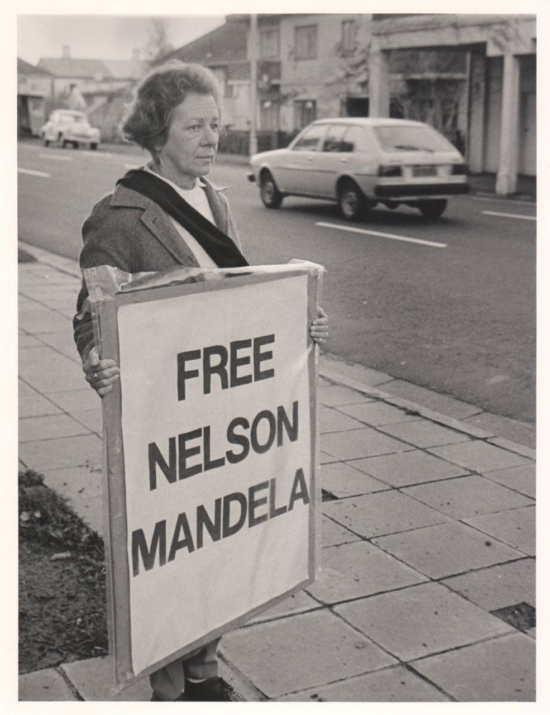
On the day he was released from prison on Robben Island, Nelson Mandela shouted out the Black Sash organization (along with NUSAS), calling them “the conscience of white South Africans.”
Denise Ackermann, who writes on the imaginative praxis that should be at the heart of the church’s pursuits of justice in the world today, commends the Black Sash.
The story of the Black Sash tells of a concrete struggle for justice carried out by a group of women. . .Their record is one which calls the church to account, even today. . .it holds out hope and encouragement for all who wrestle with what it means to become actively involved in the practice of one’s faith. And, not least of all, it encourages us today. . .to use our imaginations in the pursuit of a better world.
When all the guilt I have dutifully stored up in my liberal, well-meaning, middle-aged white lady psyche is not, actually, helping anyone all that much?
Let go of the guilt and have a little fun.
When jerking the steering wheel of our own lives does nothing to change the course of the ocean liner?
Go ahead. Even if it doesn’t course-correct for everything that is wrong with the world, veer out of your lane to sideswipe injustice every once in a while.
What are we supposed to do when the injustice seems so big and even our best efforts are inevitably too small?
Show up anyway because hell hath no capacity to irritate like a Karen activated toward justice.
*Every Karen I have ever known in real life has been a wonderful human being. I *am* sorry your name has become a meme but, maybe this blog can help you reclaim the goodness behind the trope?

14 Responses
Meg, what a fantastic re-set of a put-down. Thank you.
I especially liked the phrase, “veer out of your lane to sideswipe injustice every once in a while.” This is a punch that we need to continue to speak up and act out. It helps maintain our sanity in the hopes that we can change the world.
Great writing. Great substance. Thanks!
So good, Meg, but waah, 40 years? I won’t be alive to see things corrected if that’s how long (or more) we have to keep this up. But I’ll proudly and humbly continue my Karening as long as needed and the next generations will have to follow. 😘
Thank you! Now I know what a “Karen” is. I’m a little slow. Well written and researched. I appreciate the hard work.
Thx much, Meg. Not surprisingly, I’d never heard of Black Sash before. Yes, Hell hath no fury like that. Wonderful.
Meg, thank you for the example of how important faithful engagements for justice are. On a very tiny scale you reminded me of my time sitting at a CRC synod wearing a white robe or holding a dove with a broken wing. Men and women pinned on white carnation boutonnières at a Calvin Seminary graduation in 1988, all in support of those women responding to a call to preach and minister in the church. The ship turned slightly. Many of us have already boarded another ship since then. Still, it was worth the time and energy to stand for truth.
Thanks for sharing a bit of history that few have ever encountered. I hope and pray we can encourage such “Karen-ing” to adapt and grow in today’s challenging world. Thanks!
Thank you, Meg. I did not know about the Black Sash women. I’m curious what their husbands (if they were married) thought of their protest. I have always felt sorry for all the Karens whose name was ruined by one bad Karen. I would not like it if people started using “Dave” as a pejorative name. But it was brilliant to flip its meaning around to talk about Karens for justice. It’s sort of like how the followers of Jesus embraced the nickname “Christian,” even though it may have originally been used pejoratively. Or how we young followers of Jesus in the 70’s embraced the pejorative name “Jesus freaks.”
Despite the EXCELLENT message conveyed in Meg’s piece, it’s painful to hear the name Karen used in vain, when someone by that name who is close to me finds it more than annoying. Hopefully this too shall pass!
Thanks, Meg!! Another manifestation of a “long obedience in the same direction.”
Thanks Meg, very thought provoking. I was unaware of the Black Sash history. Would there be an impact if every “friend of democracy” of any gender would wear a black sash to oppose the current erosion of democracy in the USA and throughout the world?
😙👌
Thank you. I may co-opt “Hell hath no capacity to irritate like a Karen activated toward justice.”
It was interesting reading about the Black Sash ladies who made a very powerful contribution to ending Apartheid by the manner in which they carried out their opposition. Seventy years later, a modern example of a *Karen* or Black Sash lady would be Nick Shirley and his side kick David in Minnesota. I think it is important to point out on the RJ bog that the groups of people considered privileged and the groups of people considered victims can change over time. Not to mention, in both cases, there are always people willing to look the other way when injustice takes place if it suits their narrative or interests.