Rabbi Sharon Brous is my best friend, except she doesn’t know it.
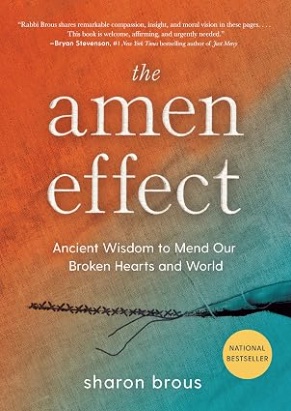
I wouldn’t say I’m her stalker, but I do listen to all of her sermons, and, when her book was published, I read it with voracity and proceeded to recommend it to every clergy colleague and book club in my realm of influence. And, I’m planning a trip to Los Angeles to go to IKAR — the synagogue she founded — before the beach!
Fine, that’s not quite true. A better definition of my relationship to Rabbi Brous might be “fan girl,” and it’s well-deserved on her part.
Brous’ book The Amen Effect: Ancient Wisdom to Mend our Broken Hearts was published two years ago in the wake of the pandemic and political turmoil both in the United States and in the Middle East, following the attack by Hamas on Southern Israel on October 7, 2023. It’s hard to separate a review of Brous’ book from her preaching, because they are both so enormously reflective of the other and her ability to relate the Torah, Talmud, and midrash to her ministry and the modern experiences of Jews and all marginalized people. She has an extraordinary ability to weave together the most historically difficult theological concepts and millennia of human suffering with interpersonal human relationships that are fresh and sacred for all of those seeking connection and shared purpose.
The first chapter pulled me in when she told a story about the collision of her seminary learning and a moment of ministry caring for two parents in profound grief over the death of both their children in a car accident. In her years of study, Brous thought to photocopy a Mishnah deep in obscure Rabbinical teaching that stood out to her, but its pull didn’t quite make sense until a decade later, when she found herself responsible for being present to and making meaning of grief, hurt, and where God was in the midst.
The image in the Mishnah depicted an ancient pilgrimage ritual that would guide seekers to the Temple Mount in Jerusalem, have them enter a courtyard to the right, walk, and then circle back to the entrance to complete the journey. There was one exception, though – those who were living through some loss or broken-heartedness would enter left, and every person they encountered on the well-worn path from the other direction was obligated to inquire about their agony and listen.
Brous uses this image to explain the purpose of our faith communities, which is that ‘we exist to show up when we want to retreat, listen deeply to each other’s pain even when there are no words, grieve and rejoice together and recognize that even though we can’t heal each other, we can and we must see each other.’ This, she writes, is the “amen effect,” — the balm for so much of our modern isolation, loneliness, despair, and dissonance. The Hebrew word for amen is emunah, which means, she writes, “I see you, you are not alone, and I bear witness to your joy and pain.”
As an elder millennial clergywoman navigating ministry among those who have been rejected by damaging theological [mis]interpretation, those who cling to certain traditions, and all those who are seeking to follow God faithfully — and even joyfully — in oppressive times, I find Rabbi Sharon Brous to be a refreshingly dynamic interpreter who roots us in ancient wisdom and ties it together graciously with a pastoral sensibility. Brous brings a bold witness to her community, Jews who have endured so much, and highlights the narratives of so many Americans from colonization and slavery to the civil rights movement and immigration. Rabbi Brous claims text alongside truth, rejecting any suggestion that diluted versions of the Bible will better serve the “nones” or those struggling with religion or its impact. Instead, she doubles down on the intricacies of biblical literature and liturgical movement alongside the real experiences facing not just her congregants but the majority of us who lament and rejoice but have nowhere to “put them” or “embody them.”
It is precarious to be a Rabbi in the United States these days, speaking to a community wrestling with theological and historical commitments to the people of Israel, while watching another marginalized people suffer and die at the hands of powerful people who are using all of us as pawns for geopolitical gain. In the midst of it all, Brous writes unpretentiously and preaches honestly with the heart of a co-journeyer and the voice of a prophet for the 21st century.