
O.K. I’m going to get this off my chest once and for all. I have sputtered and complained to myself about this, but it is time I say it out loud.
I cannot abide applause in church.
Now, don’t get me wrong, I am an open-minded accepting sort. I am tempted to explain myself here, recount my steady trek from my fundamentalist youth when we were taught to be know-it-alls, kind and loving ones, but know-it-alls just the same, to an increasingly mystical view recognizing that the more I learn, the less I know. But I will resist and stick to the point.

In my experience, applause has been a trend gaining traction in American Protestant churches. The choir sings, a guest sings, a rock band rocks on, and, lo, the gathered crowd breaks into enthusiastic applause. Why, Joel Osteen even garners applause at key breaks throughout his sermon. I envision the illuminated APPLAUSE sign cueing the crowd as Joel basks in the adulation and slowly blinks his eyes in that sultry Elvis way.
While I risk waxing didactic, “In worship, music is not to be for entertainment or artistic display.” So saith the Constitution of the Presbyterian Church (U.S.A.). And this is the point: worship is to be directed toward God.
Historically, across faith systems, worship has been the practice of discerning instruction and then responding to God. That hour or so some of us spend at church is, in its entirety, an act of worship. It is not a concert or a lecture. It is an effort to glean meaning—from text, history, and music—to shape our human existence. We listen, and consider, and respond by addressing God ourselves in shared spoken words, in collective and individual prayer and in more music. Tell me, why, then, should we be jarred out of that space by a round of applause for a human performance.
Am I being judge-y here? Do I risk violating that cherished maxim from Christ’s Sermon on the Mount? “Judge not lest ye be judged.” Could I be backsliding into that know-it-all teaching of my youth or am I allowed to express my frustration with this intrusion?
I recall that the composer, Leonard Cohen, described the source of his music as something invisible, almost an echo, a gift of grace from Bat Kol, the feminine voice of God. Cohen would hear and then write it down.
To that, I say, Hallelujah!
If, in church, I must strain through the concussion of many pounding palms, how am I to hear her whispers so I can compose the melody of my life?
Recently, when I shared my frustration with this issue, I was asked whether I felt the same about applause following the postlude. What a great question, I thought, and a fair one.
I do, indeed, applaud after the postlude, that final expert production of some of the church’s most complex music, done with all the drama of a magnificent pipe organ complete with rousing blasts of trumpets. The possibility of my own hypocrisy had not occurred to me. Am I guilty of disturbing the peace of a fellow worshipper? I decided I must think this through.
I enjoy certain structures in my spiritual life: the liturgical calendar, the order of worship. These were lacking, or minimized, in my early religious training. Now, I often note these structures because they enhance my experience. But how does this inform my thinking about the postlude?
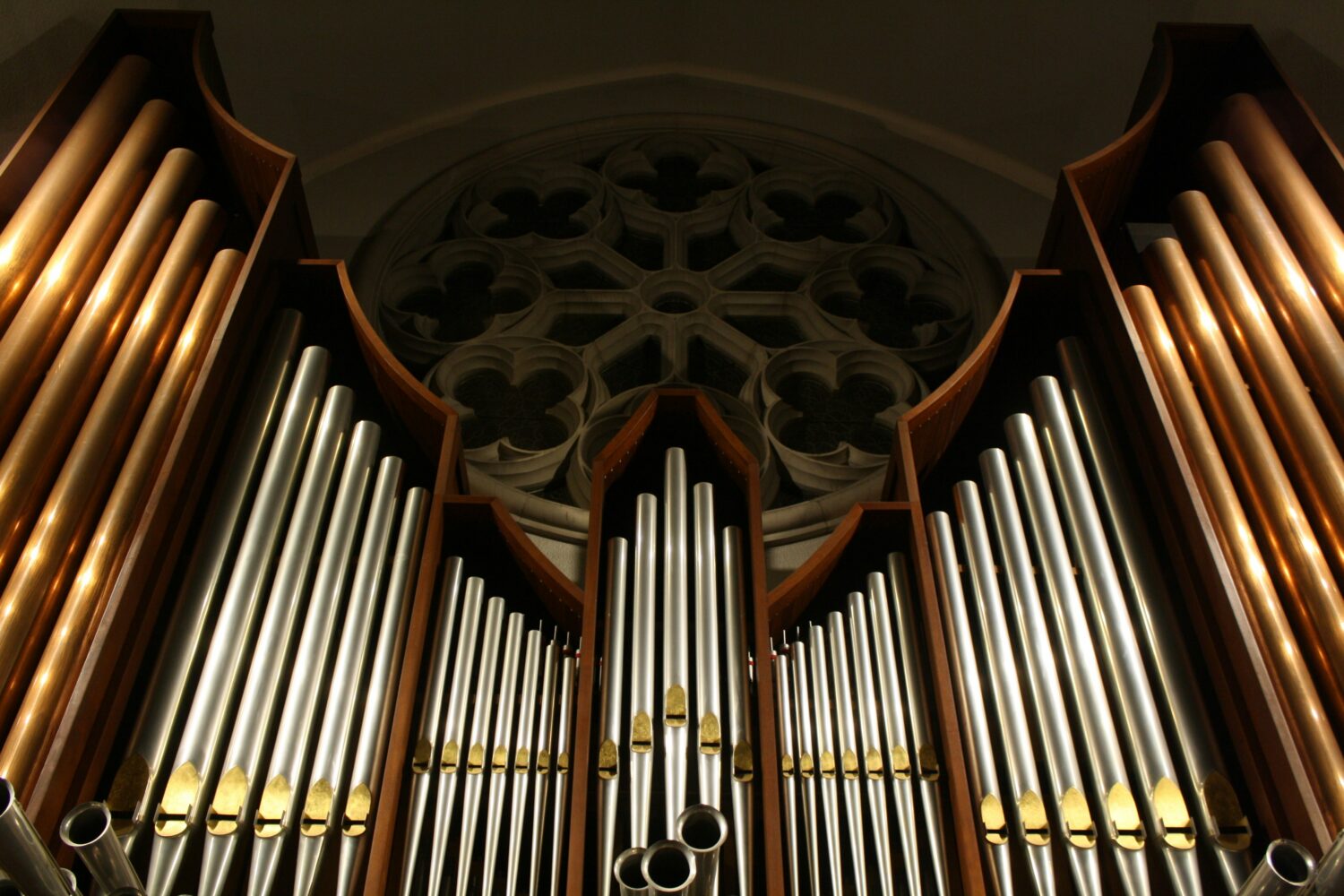
Of course, “post” is a prefix indicating “after,” so perhaps I am operating under the assumption that this musical selection is taking place after the service has ended. If so, then that is what allows me to share my enjoyment for the exuberance of the piece played after. Further, I recall my own pastor’s words at the close of our Sunday morning worship time before he exits the sanctuary: “As our worship comes to an end, our service is just beginning.” Aha!
So, the issue is settled. I am grateful I was asked the question. It led me to reflect and arrive at a point where I feel vindicated in two things: both expressing my appreciation for the musicians after the organ postlude yet, still, am allowed to struggle with applause that mars my experience. I recognize the latter may present my next opportunity to grow: finding tolerance for the range of joyous responses my fellow congregants feel moved to express.
Years ago, I recall my mother-in-law, a lifelong member of a Reformed Church in America congregation, commenting on some newer members of her church who were lifting their arms in praise during the service. Wilma was a reserved person who also lived her life with evident appreciation for those around her. “I don’t mind,” I recall her saying. “If that’s how they feel moved to worship, it’s alright. At least they’re coming to church.”
The grace in her words echoes in my memory and gives me cause to wonder: perhaps I still have some residual know-it-all thinking yet to shed.

13 Responses
Well I get this! This aspect of worship action affects me the same way. And I ask myself the same questions that you do, primarily, am I being judge-y here? It’s a conundrum for me partly because I recognize that I’m not consistent in my reservations and actions at all. I comfortably applaud when the children’s choir sings. However it seems then we’ve made their singing a performance rather than worship. I comfortably applaud after the postlude. But otherwise applause in worship startles and jars me. Clearly that’s not what it feels like to everyone. Ah what varied worshipers and creatures we are.
I appreciate the ambivalent note you end on. Thirty years ago I was on a synodical study committee on worship. We addressed the applause question in a Q & A at the end of the study and decided that any absolute rule regarding “applause or no applause” was not a hill to die on. I still like the answer we gave back then.
Q – Some people in our church think applause is wrong because it praises the performer instead of praising God. What’s so bad about doing both?
A – It depends. Here is one of those issues that require great doses of wisdom and common sense. We cannot come up with rules for applause. Consider the following examples of where applause might be a spontaneous and totally appropriate way for a congregation to express its joy or appreciation or love: the recognition of a couple who have been married fifty years, the recognition of the members of the second-grade Sunday-school class who have been presented their Bibles, the announcement that a mother who has been in the hospital for three months has safely delivered triplets, the announcement that a beloved pastor has declined a call. Spontaneous applause that expresses joy and thanksgiving is not alien to the spirit and purpose of worship.
Applause becomes more problematic when, in essence, it is something programmed. To give applause every time someone sings a solo in church, regardless of whether the solo moved you or not, quickly becomes programmed applause. Such applause is also arbitrary. Why applaud soloists only? Why not applaud a great sermon or a great offertory by the organist?
Applause is one way in our culture that we express joy, appreciation, honor, and thanksgiving. (“Amen” is a form of “verbal applause” that serves the same function in some churches.) The challenge is to keep applause from being predictable and, in fact, cut off from genuine feelings of joy, appreciation, honor, and thanksgiving. When applause genuinely expresses those feelings in the context of our relationship with one another in Christ, let it happen.
Very true. Sometimes we have an issue with applause because we have an issue with spontaneity itself.
Clapping in church is completely inappropriate, and the reasons are really very simple. We are in church to worship God, not man. We are in church to Worship God, not to be entertained. We are in church to experience the presence of Christ, not to have a human-focused worship experience. You are not being judge-y. You just have the correct theology and worship focus.
You have presented an issue for the legions of purists in the world of liturgy and worship. Being an organist my whole life, no one ever applauded a magnificent prelude or offertory, some did for postludes, but, even though I was confident and secure in my choices of music and abilities (proud), I knew what was played was part of the entirety of the worship of God. For anyone participating in worship, be it musician, layperson, or minister, there is always a fine line between worship and performance, which is inevitable.
However, applause does break out spontaneously in our worship at times and I, like you, have had to sit with that slightly uncomfortable feeling that many in the pews are not realizing that our worship is not a ‘show’ put on for God, to highlight our devotion and the talents of some. Interestingly, we hear deeply relevent sermons, week after week, which could warrant applause, which never happens. I agree wholeheartedly with the synodical committee’s answer that Duane shared, that our fellowships should strive to not let it become predictable, but spontaneous. Then it becomes the ‘amen’ that flows from our hearts.
Applause and its appropriate place in worship is an age-old problem with no one-rule absolute.
This past Sunday we had an opportunity to hear from a local assistance ministry (SECOM) about the help they are giving our city’s poor and needy. In other words, helping those who are dearest to God’s heart.
I heard of their efforts to help and provide, I sensed their appeal to assist them financially and my heart said, thank You, Lord! My reaction of applause was gratitude to God and those being His hands and feet. It would have been inappropriate – for me – to muffle this praise.
Nice!
Friends,
Where I worship it is SO predictable, instead of spontaneous.
We got it from Garden Grove I’m sure.
How can we change a worship culture so it is more appropriate?
Thanks for this contribution and the following discussion.
I, too, have a problem with applause in church. I will lift up my hands in worship and respond with an occasional Hallelujah! To a moving song or sermon point. But applause to me seems inappropriate. Maybe it’s because I equate applause to be directed toward the performer and not toward God. Maybe it’s my issue. So I hold my applause and allow those who wish to do so to participate.
Poke anyone hard enough and you’ll eventually find a fundamentalist.
There are all kinds of reason to clap—good and bad. We can clap in appreciation for what God has done or what he has done through one of his servants. We can clap to keep a beat by joining our hearts and bodies together in worship. We can clap to join the trees in praising the Lord (Ps 98:8). We can clap for joy (Isaiah 55:12). We can clap to encourage. We can clap in order to mindlessly go along with the crowd. We can clap hypocritically. We can clap to hurry things up. We can clap to call people to attention. We can even “clap back” at those we disagree with or are disgusted with, or are glad finally got their comeuppance (see Lam. 2:15; Ezek. 6:11; 21:17). Most activities that happen in worship can done with a focus on God and each other as the body of Christ…or they can be done by just going through the motions, or lacking an awareness of God, or hypocritically, or with a focus on ourselves, or just trying to look good or fit in. We don’t stop singing because some are not focusing on God. We don’t stop saying the benediction because some are just going through the motions. We don’t stop preaching because some preach to get attention and some are just listening for a funny story. I agree that clapping that has become a routine response to a song is not a good step. Yet Psalm 47:1 calls us to clap and shout to God with joy. When that’s what compels us, let’s do it. A shout would be good too.
When the sanctuary becomes the worship space or auditorium, the platform becomes the stage and the order of service becomes the program applause seems inevitable. Words matter.
I typically find the lack of the applause more troubling than the applause…. Psalm 100 discusses both the noise and the singing–i.e. the singing is not necessarily the joyful noise. In that vein, it has always struck me as odd that often in church, we expect that no one should ever make a joyful noise even when a piece of music, a sermon, or whatever was particularly moving and left me full of joy and I assume many others. But the only sound is deafening silence. Different strokes for different folks, I suppose, but it’s one part of Reformed churchiness I wish we could do away with.