
One of my favorite classes to teach is Philosophy and Science Fiction. As expected, much of what we discuss involves the philosophical implications of various futuristic technologies, including Artificial Intelligence (AI). When I taught this class for the first time way back in 2001, our discussions of AI were primarily science fictional as we examined our favorite robots and computers from the movies. Of course, we now face plenty of pressing real-life questions about all too real AI technology and its application in the military, in the arts, in business, in higher education, and in virtually every area of our lives together.
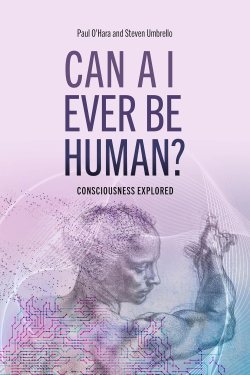
We sometimes distinguish between weak and strong AI. Much of our more practical discussion of AI today is about weak AI, in which AI is deployed to perform some narrowly defined task, as when Deep Blue was famously programmed to play chess in the 1990s or when my dentist uses AI to help examine my x-rays. There is no doubt that AI can be extraordinarily competent at executing such tasks, often outperforming us. Yet we still wrestle with the most fundamental and still somewhat science fictional questions about the possibility of strong AI. Can a machine really be intelligent, in all the ways that we are? Can a machine actually be one of us, in some meaningful sense? Paul O’Hara and Steven Umbrello ask and answer these questions with a resounding no in their new book Can AI Ever Be Human? Consciousness Explored.
Philosophers tend to focus on questions as much as answers, ensuring that we understand what a question means and that it is indeed the question we wish to ask. In this titular question, the word “ever” is crucial. It is one thing to argue that current computing machines fail to qualify as strong AI or even that AI as it likely will develop in the next several years will not meet that standard, but it is quite another thing to argue that no imaginable AI can do so, whether in the distant future or even far off somewhere else in the universe. Much of the time, the authors of this book seem primarily to be focused on current AI. This sometimes makes their job a bit easier than it ought to be, given their title.
I confess I am a bit puzzled by the question whether AI can be human. In one sense, it seems obvious that a computer or robot is not a human being, no matter how impressive and marvelous it might be, for a human being in this sense is a member of a particular biological species. In the same way, the adorable alien Rocky from the recent movie Project Hail Mary is also not a human being, at least not biologically. And yet the reluctant astronaut Ryland Grace as well as theaters full of moviegoers evidently find Rocky to be one of us, no matter how strange he might be, to be a person rather than a thing, to be someone who deserves our concern and who could be our friend. I think our real question about AI is whether AI can be a person in this sense, whether AI can be human not physiologically or genetically but in some deeper and more difficult to understand kind of way. After all, an AI could be a very different sort of person than we are, just as Rocky is.
The general contours of O’Hara and Umbrello’s case against strong AI are familiar. Throughout, we read that AI is not capable of creativity, insight, and curiosity, that AI can only simulate or emulate cognition and emotion and other aspects of humanity but does not actually understand or feel anything, that AI is not conscious, that AI cannot love. As they memorably put it a couple of times, with AI there is just nobody there (163, 206).
What is distinctive about the arguments they make in this book is that they work with the method and framework of the twentieth century Catholic philosopher and theologian Bernard Lonergan. Each of the book’s five main chapters takes up a different key concept in Lonergan’s philosophy: insight, experience, understanding, judgment, and decision. In reading this book I believe I learned more about Lonergan than I did about AI, and that’s not a bad thing at all. Unsurprisingly, it also turns out that the book is as much about humanity as it is about AI. Whether one thinks AI can be human will naturally depend not only on one’s take on AI but also on one’s view of what it means to be human. In each chapter our authors give a Longergan-inspired account of some key aspect of humanity and then argue that a machine cannot replicate this aspect. A machine cannot truly have insights, or experience the world, or understand or judge or make decisions.
Is their case against strong AI convincing? How we answer this question is likely to depend on our overall posture toward AI and technology more generally and our overall worldview and humanity’s place in it. O’Hara and Umbrello acknowledge that their main opponents include transhumanists like Nick Bostrom who are enthusiastic about a prophesied merger between humanity and AI as well as materialists like Daniel Dennett who work to make sense of the human mind on the model of a computer. The former predict that the line between human and machine will become increasingly blurry and the latter regard the human mind as a complicated organic machine. Such folks do not see an artificial person as a problem and I doubt that they will be convinced otherwise by this book, largely because our authors’ arguments so often reflect their evident commitment to a broadly Christian and decidedly dualist view of things.
For O’Hara and Umbrello, to be human involves being a mystery to ourselves (e.g. 1, 51, 73). There is just something “more” about being human that cannot be captured by a machine. They frequently refer to the gap between God and Golem, a reference to Norbert Weiner’s 1964 book God and Golem, Inc. For example, “while robots can be programmed to mimic life (Golem), they cannot possess the divine spark of creativity, consciousness, or life itself (God)” (46). God alone creates persons like us. We make (or sub-create) complicated machines that perform impressive feats and that we design to pretend to be like us, but they can never be us. For our authors, AI is a Pinocchio that can never be a real boy, Steven Spielberg’s 2001 film A.I. Artificial Intelligence notwithstanding.
Can a machine ever be one of us? Could we even be machines ourselves, but ones made out of meat instead of metal? The traditional and familiar answer to these questions, for Christians as for most other traditions, is no. As I finished reading this book, it struck me that perhaps the very notion that we are a mystery to ourselves provides us with a good reason to be open to rethinking our answers to such questions?
2 Responses
To my mind, one of the best treatments of this is found in Isaac Asimov’s Foundation saga. Especially in his later books, Asimov is constantly asking the question, “What does it mean to be a person?”
No, robots are not human, nor can they be. But could a robot/AI be a person? No matter how one chooses to define ‘person’, R. Daneel Olivaw is a very close fit.
It also appears that our current AI mavens know nothing of Asimov’s three laws of robotics, including the zeroeth law. That would be a fine place to start, if we weren’t so dead set on using AI to kill each other.
It’s becoming clear that with all the brain and consciousness theories out there, the proof will be in the pudding. By this I mean, can any particular theory be used to create a human adult level conscious machine. My bet is on the late Gerald Edelman’s Extended Theory of Neuronal Group Selection. The lead group in robotics based on this theory is the Neurorobotics Lab at UC at Irvine. Dr. Edelman distinguished between primary consciousness, which came first in evolution, and that humans share with other conscious animals, and higher-order consciousness, which came to only humans with the acquisition of sophisticated language (especially math and logic). A machine with only primary consciousness will probably have to come first.
What I find special about the TNGS is the Darwin series of automata created at the Neurosciences Institute by Dr. Edelman and his colleagues in the 1990’s and 2000’s. These machines perform in the real world, not in a restricted simulated world, and display convincing physical behavior indicative of higher psychological functions necessary for consciousness, such as perceptual categorization, memory, and learning. They are based on realistic models of the parts of the biological brain that the theory claims subserve these functions. The extended TNGS allows for the emergence of consciousness based only on further evolutionary development of the brain areas responsible for these functions, in a parsimonious way. No other research I’ve encountered is anywhere near as convincing.
I post because on almost every video and article about the brain and consciousness that I encounter, the attitude seems to be that we still know next to nothing about how the brain and consciousness work; that there’s lots of data but no unifying theory. I believe the extended TNGS is that theory. My motivation is to keep that theory in front of the public. And obviously, I consider it the route to a truly conscious machine, primary and higher-order.
My advice to people who want to create a conscious machine is to seriously ground themselves in the extended TNGS and the Darwin automata first, and proceed from there, by applying to Jeff Krichmar’s lab at UC Irvine, possibly. Dr. Edelman’s roadmap to a conscious machine is at https://arxiv.org/abs/2105.10461, and here is a video of Jeff Krichmar talking about some of the Darwin automata, https://www.youtube.com/watch?v=J7Uh9phc1Ow