
So, here you are, too foreign for home, too foreign for here. Never enough for both.
— Ijeoma Umebinyuo
Leaving home
Home is everywhere and nowhere. The last few years have been years of thinning. Thinning things when we sold our home to live in an apartment, so we could spend more time with family in Boston and Boulder and reconnecting with our wanderlust in Europe.
It has also been a season, years really, of thinning friends. Did they pull away or did I or was it a little of both? And then thinning family as we lost my dad to Alzheimers two years ago this October. Thinning is at times a choice and others not. Sometimes it is a releasing and at times a desperate grasping until finally having to let go of what we can no longer hold.
I wonder about those whose thinning has little to do with choice, when leaving the home they love. We speak often of immigrating, the coming, and little of emigrating, the leaving. I wonder if when my Nana Grace emigrated from Italy at five years old, how much choice was involved and how much thinning they experienced leaving home. Did she pack her anxious thoughts next to her curiosity and grief as they prepared for a long boat ride to a new country?
I pack my travel cubes and stuff them into my backpack to prepare for our upcoming month of what we choose to see as relocating home. I remind myself I always overpack. And this trip has quite a few transit exchanges. So, less is more. Back to thinning.
When we travel out of state or the country, I notice my nervous system relax. I feel spacious. From the outside it can look like judgement on a place we have called home for 14 years but on the inside, it is a complicated mix of grief and relief. It is an exhale and long breaths. Curiosity replaces judgement and protest. I know I am a healthier version of myself when I leave. I do not know how to explain that without offending and am sure I have. I am reminded of a response Paul shares when people ask why he likes the UK so much. He says, “I like myself better there.” That feels as close to truth as I can get.
Remembering Home
Before going abroad, we stopped in Boston, for a few days to visit my mom in the home where I grew up. One morning, we ventured up to the North Shore to visit her 99-year-old, Auntie Paula, sister to my Nana Grace. We came with cookies and questions. What town in Italy did they come from? How old was she? Did they live in East Boston or Little Italy? What did they do for work? It occurs to me now, we never asked Auntie Paula, why they left home.
“Grace came from Bonito, Italy when she was five.” Auntie Paula explained as she ate one of my mom’s pizzelles. “You didn’t leave them in long enough. They need to be darker,” she advised my mom — “but they’re good, lots of sugah.”
First generation Italians treated cooking and baking as both a love language and a survival skill passed down with precision and care. Generations of Belmonte women’s hands worked dough and stirred oversized pots of sauce and meatballs, always enough for a crowd. Sharing a meal was communal. It was a sacred act to gather around a table bursting with pastas and meats and cheeses and wine and breads and pulsating with passionate voices all speaking at once. It makes sense why Italians speak with their hands — when everyone talks at once, words are simply not enough.
Sharing Home
Sitting on a ferry from Dublin, Ireland to Hollyhead, UK, I notice how easily we have crossed borders, how my navy-blue American passport and fair skin affords me easy access. I reflect on my Irish ancestors and how they had to journey across the Atlantic and wonder if access came as easily.
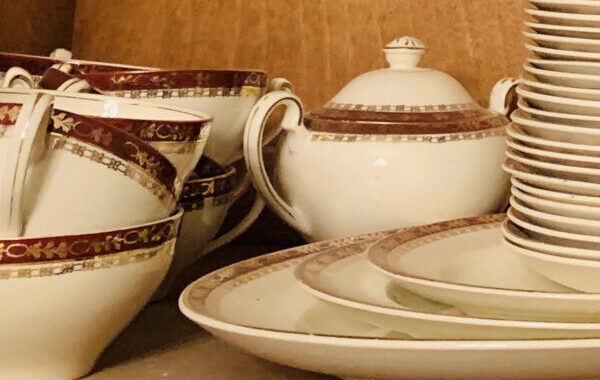
As we leave the Irish shoreline, I recall another departure. We were preparing to sell our home of nine years, moving from the suburbs to the city when our youngest graduated from high school. We were downsizing, an idea like minimalism for those with more than enough. I stood in my kitchen and held a piece of my nana’s China in my hands, passed on to me from my mom. I admired its ornateness, a thick burgundy line with delicate gold embossing. Maybe she began collecting it when she married my grandfather in East Boston. Or maybe they had it in the small apartment in the six family they shared with her parents, Auntie Paula, Auntie Mae, and the rest of the Belmontes who had emigrated. The home where “the twins,” my mom’s cousins, ran around the maypole with my mom in the small chain-linked backyard, and where my uncle Art stole whisky soaked cherries from the barrel in the basement, and was chased out by his nana with a broom.
I looked up at the rest of the set of dishes in the cabinet above and realized it was time to give it a new home. Like other items no longer mine to hold onto or grasp, the storied China set would find a new home with my dear friend and former student, Toba, a mother of three from Afghanistan, and a recent immigrant herself. She arrived as a refugee at 19 with her husband who was a military translator.
When we moved to the Netherlands, we were expats while others are immigrants, asylum seekers, exiles, outcast, foreigners, boat persons, illegals, and worse names I refuse to repeat. Why do we use labels to place some above others? Does it make us feel safer to know someone is below us? I heard stories of derogatory name calling of both my Irish and Italian ancestors. I know life was not easy for them as they struggled to make a new home in America. When I hear these labels used today, I wonder if we are afflicted with a collective amnesia about our own family histories.
Coming Home
Over my 10 years of teaching and sharing life with my Afghan friends, I discovered hospitality is their first language. We gathered often for birthdays, baby showers, graduations, and Nowruz (Persian New Year). Much like my Italian ancestors, their doors were open and tables were overflowing with food and conversation.
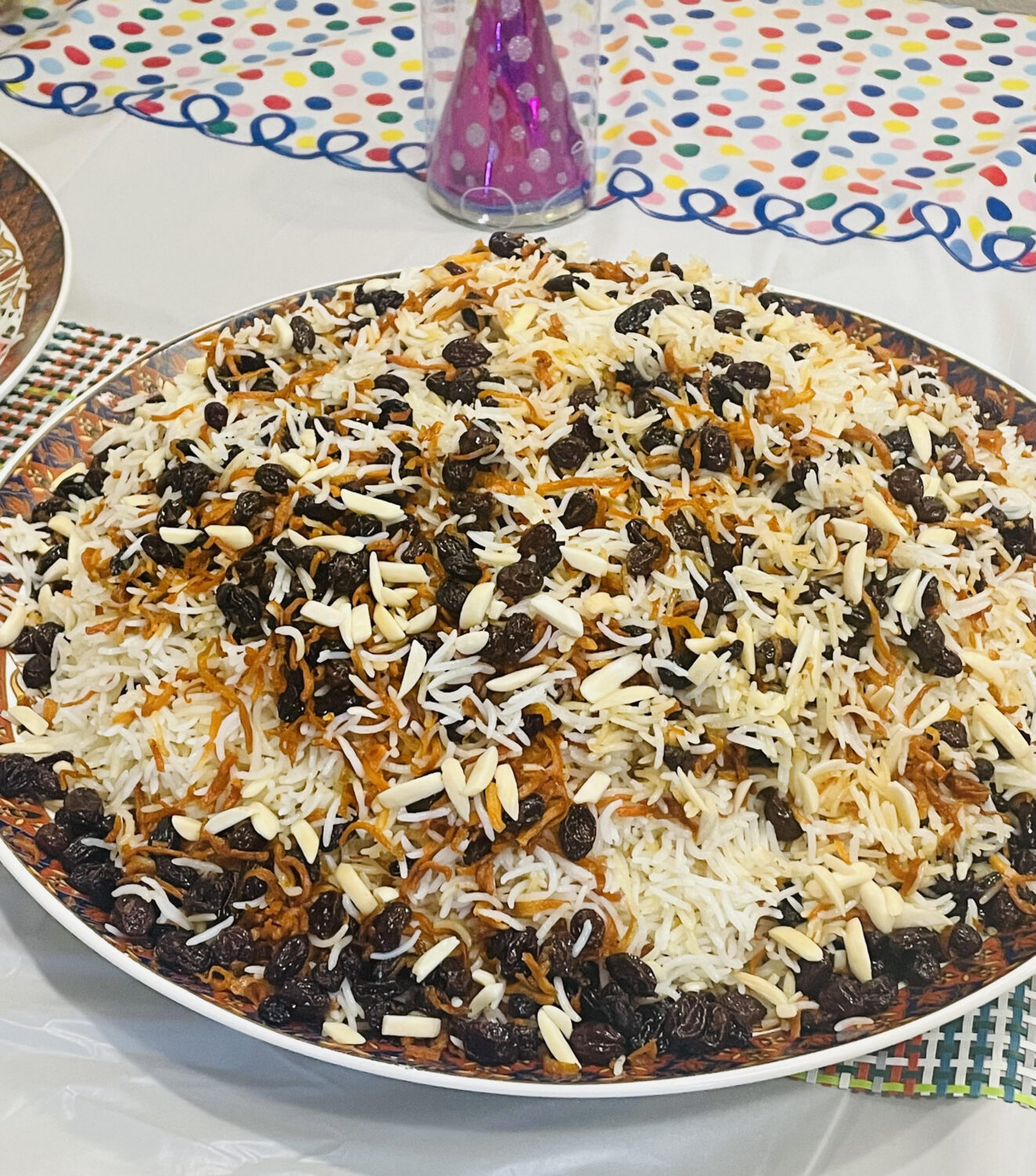
A few months after we moved, Toba invited me to her daughter’s birthday party. As I entered their apartment, I breathed in warm earthy scents of cumin and cardamom that told stories of aunties and nanas across the sea. I laughed as her kids hugged my legs with boisterous delight at more visitors. The table shone with a kaleidoscope of food she had spent days preparing in her “spare” time as a full-time working mom and student. She handed me a plate. I filled it with kabuli pulao (an aromatic rice dish with carrots, almonds, and raisins), kofta (Afghani meatballs), naan, and my favorite cucumber yogurt. I found a place on the floor between friends and paused and stared through tear-brimmed eyes at the familiar burgundy and gold design border on my plate.
It was a liminal moment, a glimmer. Nana Grace was with us, smiling and reminding me of the beauty of family, friends, shared stories, and home.
10 Responses
A beautiful reminder of ‘home’ being in different places and times. What a treasure of memories and family you have, Kerin.
Thank you, Jean. I really love the concept of a home as a sense of interconnected time, place and relationship.
“…while others are immigrants, asylum seekers, exiles, outcast, foreigners, boat persons, illegals, and worse names I refuse to repeat. Why do we use labels to place some above others? Does it make us feel safer…”
This! Thank you, Kerin, for this beautiful piece with so much tenderness, memory, and challenge to expand the table and find the path to be the best version of ourselves.
“Expand the table”… Yes!! Thanks for this reflection, Kathy!!
Kerin, I’m always filled with happy anticipation when I see it’s YOUR writing I’m going to get to read when I open the RJ link. And oh how lovely this is.
Thanks for your kind affirmation, Kathy. Writing feels like a wrestling match between my mind, heart and soul. My son talks about doing something uncomfortable as a means of “exposure therapy.” — pretty much sums up how it feels to hit send. I so appreciate your encouragement!
Thank you for this, Kerin! Your mention of transitioning from emigrant to immigrant provoked memories and feelings that have not found words; still searching.
Is what was a family home replaceable? I think many immigrants find it is not. If the family home that is forever left behind was a dear one, it becomes a memory to hold close.
Henry, thank you for your deeply reflective comments and questions. I relate to the “not finding words,” and sitting with language for lengths of time. I appreciate your question of, “Is a family home replaceable?” Thank you!
I was reading a book by Ece Temelkuran, while writing this piece. As a Turkish writer in exile, Ece reflects on this concept of loss of home and she begins each entry with, Dear Stranger. I have no doubt her story seeped into mine.
That is so beautiful. It brought tears to my eyes and warmth to my heart.
IF ONLY …. if only we could allow our hearts to open and our minds and judgements to rest…. if only we could remember our shared humanity. If only we could embrace one another as brothers and sisters sharing this beautiful world. I remember a time when we did! What joy and abundance is shared when we do!
Thank you, Keri ❤️
Yes, memories of our family bring a sense of “joy and abundance,” especially when I hear echoes of Nana (especially her laugh) in you and mom. Grateful. Thank you, Aunt Tara!