Every now and again, the Athletics and Recreation Centre at the university I work for runs a one-off exercise class during lunch hour that staff can sign up for at no cost. And every now and again, in a fit of fitness-frenzy, I sign up for one. The most recent one I did was called “Triple Threat”, and it was a doozy: cardio, core, and weights all combined into one torturous hour.
One cycle had us going from a standing move to one on the mat, and then back to another one standing up. On our second go through the cycle, one of my classmates grumbled amicably about the constant up and down, and our spry young instructor’s eyes lit up.
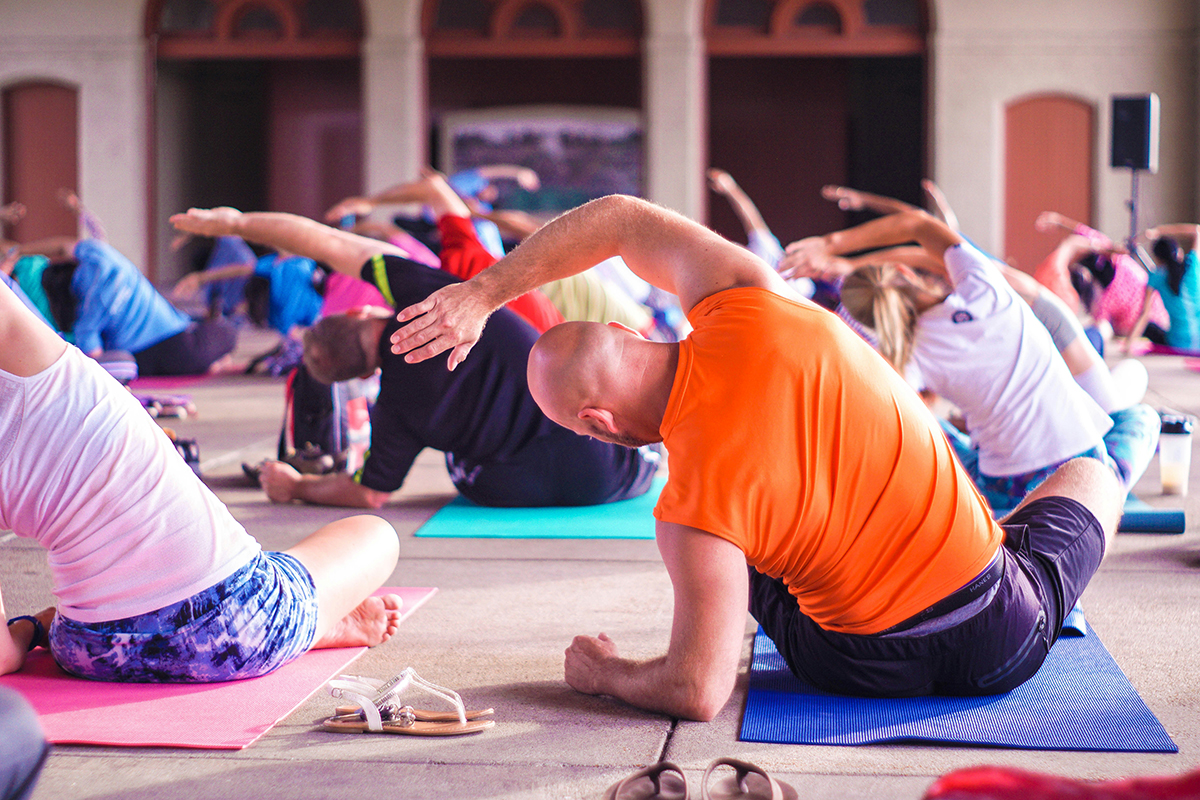 “Ah! You noticed!” he grinned. “That is on purpose! We sometimes think that the movement in a class like this that ‘counts’ is the crunches or the lifts or whatever, but the moving in between counts just as much. I like to call that ‘movement for life.’ If we don’t practice getting on the floor and getting up again, believe it or not, one day we’ll discover that our bodies have forgotten how to do it. These movements are all about our health!”
That same night, my husband and I decided to put on Our Planet II, a Netflix nature docuseries narrated by the iconic Sir David Attenborough. I hadn’t realized until it was underway that the focus of the series is on global migrations. A few minutes in, Sir David intoned some thoughts that nearly made me jump out of my chair. “At any given moment, billions of animals are on the move, and the health of our planet depends on it… Only now are we beginning to understand that all life on earth depends on the freedom to move.”
The juxtaposition of these two insights on the very same day was fascinating to me, and the ideas of individual health and collective health being defined by the capacity to move sparked my interest.
Many of us were taught that motion in our faith is a singular thing that takes place in the moment of conversion. The Saul/Paul conversion moment in Acts 9 was the ultimate metaphor; how perfect that the origin story of a fan-favourite biblical superhero is literally him on a road going in a particular direction and getting stopped and redirected by blazing light from God.
But post-conversion, our faith’s preferred metaphors tend to emphasize motionlessness as the goal state.
We recite, “Therefore put on the full armor of God, so that when the day of evil comes, you may be able to stand your ground, and after you have done everything, to stand” (Eph. 6: 13).
And we sing, “I shall not be, I shall not be moved; I shall not be, I shall not be moved! Like a tree planted by the water, I shall not be moved.” Or, “On Christ the solid Rock, I stand; all other ground is sinking sand; all other ground is sinking sand.”
But if our bodies and the world around us reveal that the strength of movement – not the strength of fixedness – is key to life and health, what does that mean for our spiritual life?
Right now, as I turn that question over in my mind and heart, I keep coming back to the book of James, and the age-old theological rivalry between faith and works. I wonder if, in using the language of “works” or “deeds”, and in our idea of “faith”, that there hasn’t been a tendency to think of those as fixed and still categories. Works or deeds are quantifiable things that we completed – and the criticism is that an overfocus on works reduces spiritual growth to a balance sheet of items. Faith is a thing that we have internally, that we stand firm with and resist shifting – and the criticism is that an overfocus on faith means we’re just standing on a Rock and having thoughts and prayers, with no measurable impact.
So then, what if both faith and works could be reframed of as full of Movement for Life? Perhaps that movement brings the dyad of faith and works into a healthy, vital, sustainable symbiosis.
Imagine that text in James 2 with language that makes us think of movement instead. With the huge disclaimer that I am in no way a biblical translator, here’s my take on verses 14-17:
What good is it, my brothers and sisters, if you claim to have strong beliefs and ideals, but those beliefs don’t help you or your community move toward health and wholeness? Can your ideals themselves accomplish anything good? If a brother or sister is naked and hungry, and one of you says to them, ‘Go in peace; keep warm and eat your fill’, and yet you don’t move to help their bodily needs, how is that loving? So faith by itself, if it has forgotten how to move, doesn’t help anyone, and eventually it’s going to get stuck on the floor when it falls down.
I’ve written before about struggles in my younger years feeling like I “didn’t have a testimony” because I hadn’t had a dramatically “moving” conversion experience within my faith story. A lot of my healing and growth out of that unhelpful mindset was being assured of my belonging as a child of God, and that’s been an important and meaningful assurance. And, I think it’s important for all of us – dramatic conversion or no – to acknowledge the many other ways that our own faith has moved over the years and continues to move. Sometimes incremental movement, like the growth of a plant captured on a slow-motion video. Sometimes a major movement, like big strides away from something unhealthy or toward something life-giving.
I was enraptured with Our Planet II. Sir David Attenborough has such a compelling way of linking the stories of individual animals’ lives with the bigger picture of species and ecosystems. I’m convinced that similarly, stories about our individual movement in our faith journeys weave into the broader stories of our faith migration in larger community groups, and this is not a sign of weak or flimsy faith, but rather the opposite. There will always be times when we need to be reassured of the firmness of our collective faith, but we must resist the temptation to conflate firmness with a lack of motion. A static faith is a stagnant faith, and no ecosystem flourishes in stagnation.
These movements, as my fitness instructor wisely observed, are all about our health.