It might seem a little out of touch to suggest that in a moment of bitterly contested midterm elections, consequential ballot measures, and global crises we take time away from the fray to find a quiet spot and reread The Scarlet Letter.
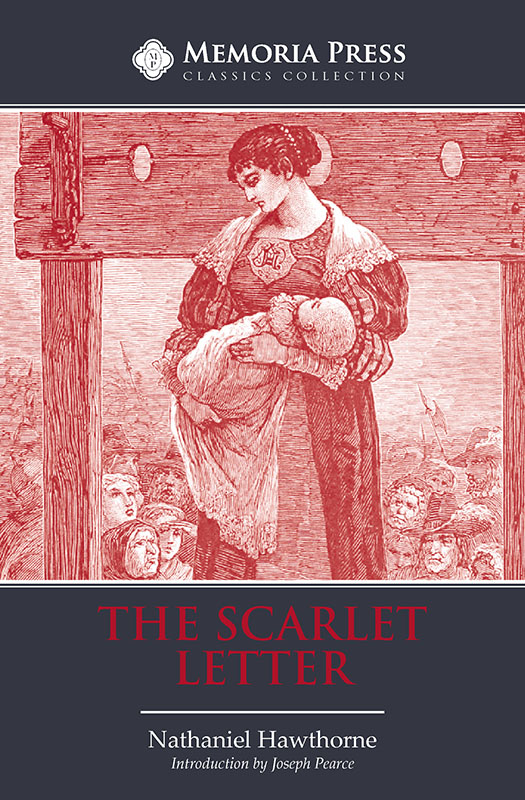
Still, I am suggesting it. Sometimes an old book meets a new moment with such startling relevance the decades that separate writer and reader seem to dissolve.
This little American classic, not altogether beloved by generations of hapless high school students, takes sharp aim not only at the governors and clerics of a small 17th-century Puritan settlement but also at the legalists and moralists, judges and pastors, “Scribes and Pharisees” of Hawthorne’s own generation. Some of its barbs land pretty squarely in ours.
Published in 1850, the book was both a deceptively familiar kind of moral tale and a deeply subversive challenge to readers to read better. Far more pertinent than an invitation to ponder the sin of adultery (a word that never occurs once in its 24 chapters), The Scarlet Letter is a book about the sin of misreading, or failing to read, the messages inscribed in sacred texts and founding documents as well as the signs encoded in the natural world. It’s a book about the power and mystery of words and signs, and the peril of reducing them to instruments of ambition or agents of deception.
Romantic that he was—and that word has endured a long history of misapplication—Hawthorne’s heterodox hermeneutic rested on the premise that we are always being addressed. Invited. Summoned. Warned. But the messages that come to us from the divinity that “shapes our ends” are subtle, often ambiguous, and come in ways that defy codification. So those messages resist simple decoding. Where the law is rigid and univocal, they are fluid and multivalent. Where the institutions of law and governance are hierarchical, they direct our attention to the lowly and the outcast. Does this sound familiar?

1804-1864
Hawthorne, like his fellow Transcendentalists, kept a skeptical distance from the church, but gave more thought than most to the implications of the Gospel, especially with respect to what we inscribe, elevate, and institutionalize. His own sentences, some of them syntactical mazes, often begin with “Perhaps” or “It may be.” Many offer two equally plausible interpretations of events: whether the meaning be this or that, “We shall not take upon ourselves to determine.” With the help of his notoriously unreliable narrator he plays with etymologies and the ways words carry meaning in different directions, and even of how single letters may become “hieroglyphics” that signify in their own oblique ways. At every turn we are reminded how unstable–and full of vitality–language is.
Message and meaning, the treacheries of text and the semiotics of the natural world are themes that expand like the night sky over the story. Against that rich tapestry of reflection, though, he manages to address some of the deepest, most constant challenges to human community. So, the story takes on a number of matters that seem urgently to need our attention now:
Theocracy is unbiblical, inhumane, and self-defeating.
Scapegoating enables the guilty to deflect responsibility,
Women and children are easy targets.
All have sinned. Sins of the intellect do more harm than sins of the flesh.
Grace is larger and more abundant than law.
The deepest truths are paradoxes.
Wisdom is wider than the rational mind.
Domestication destroys. What is wild in us and around us is a life source.
The letter kills but the Spirit gives life.
Every one of these is painfully pertinent to the partisan furies that fill the air around us now.
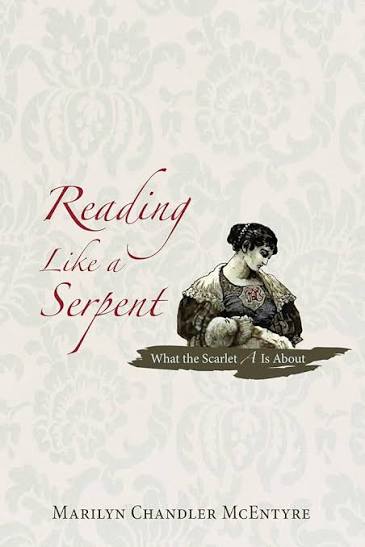
Years ago, I entertained myself for a happy season by writing a little book about The Scarlet Letter entitled Reading Like a Serpent. I wanted to call it “An American Sermon,” but the editor, with a somewhat jaundiced view of the public appetite for the term, advised against using the word “sermon” on the front cover. Hawthorne’s “American sermon” does exactly what Rienhold Niebuhr famously suggested a good sermon ought to do—it comforts the afflicted (especially those afflicted by myopic, exclusionary, self-serving Christianity) and afflicts the comfortable (those who have stood in judgment over neighbors or sacrificed compassion to preserving structures of power). It also invites readers to take seriously the role of imagination and speculation in developing wisdom that cannot be taught or enforced. It honors ways of knowing that can’t be regulated any more than the life force itself.
Chapter 13 of The Scarlet Letter, the central chapter, is the darkest in Hester Prynne’s story. Despised and rejected by men—and even more viciously by women—she finds herself wandering in “a moral wilderness,” having no community to sustain or offer her more than the barest tolerance—certainly none who share a point of view only accessible to those the church and state have oppressed. In her prolonged exclusion from loving, forgiving, life-giving human community, we read,
her life had turned, in a great measure, from passion and feeling, to thought. She assumed a freedom of speculation, then common enough on the other side of the Atlantic, but which our forefathers, had they known it, would have held to be a deadlier crime than that stigmatized by the scarlet letter.
That freedom of speculation allows Hester to take in the long history of patriarchal rule, the complicity of the church in defining crime and punishment with little reference to forgiveness and mercy, and the control of minds and hearts through fear. She arrives at the sweeping conclusion that for women to take their rightful place—and by extension, any who lie beyond the control of those institutions, “the whole system of society is to be torn down, and built up anew.”
This is Hawthorne at his radical best. His words recall Thomas Jefferson’s, now inscribed on the Jefferson monument:
I am not an advocate for frequent changes in laws and constitutions, but laws and institutions must go hand in hand with the progress of the human mind. As that becomes more developed, more enlightened, as new discoveries are made, new truths discovered and manners and opinions change . . . institutions must advance also to keep pace with the times. We might as well require a man to wear still the coat which fitted him when a boy as a civilized society to remain ever under the regimen of their barbarous ancestors.
The words evoke an amusing image of black-robed “originalists” squeezing into a very tight coat.
Jefferson’s words lend themselves to various readings, but in light of Hawthorne’s suggestion that nothing but complete demolition and reconstruction will amend eroded foundations or restore vital energy to human community, they pose a timely challenge to us as we (figuratively) hold The Scarlet Letter in one hand, the Bible in another, and, on the table before us an open page of the New York Times. And, unscrolled for the occasion, the Constitution.
Historical analogies have their dangers, but an essential question to carry into whatever we read from an earlier generation is how this old text speaks to us now. What avenues of reflection does it open in this new moment? And what are, in this case, the uses of the past?
The only way to read well is first to read in a solitude that allows for “freedom of speculation” and for deeply subjective awareness of how words, phrases, and ideas stir us to feeling, thought, and action––and then to read together, to gather over the page and hear again how many small fires may be lit by sparks from a single paragraph.
The wisdom of lectio divina as both a solitary and a communal practice is exactly that: to honor the ways the Spirit speaks within us as we read, and then to hear how the Spirit moves among us as we pool our reflections on words we’ve received from the ancestors. Reading together is an occasion to remember that we are members of one another and of the broad communion of saints who left what they could in words that shift and change, quietly erode, survive misuse, and are restored by poets, writers, preachers, and those who sustain civil conversation in the public square.
When we take time with them, some of those words shimmer and gleam and light the path that lies before us.