
“Marc, I think this is Walter’s last book” – Tia
Serendipitously and unintentionally, Walter Brueggemann’s newest book, God of All Promises, arrived on my birthday. It came in the usual way: a brown mailer from Traverse City, Michigan. What was unusual however, was that this particular package came from Walter Brueggemann’s wife, Tia, whose penmanship could be its own font. Were it not for the return address, the package would be unrecognizable.
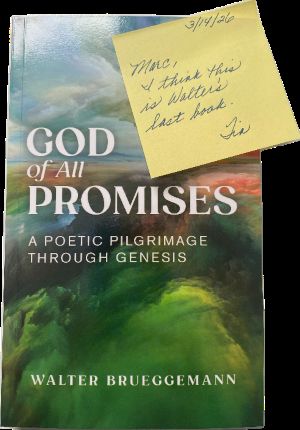
For the last two decades, similar parcels filled my mailbox on a near monthly basis, however those were from Walter. Every time I would open my mailbox and see the familiar style of envelope, I was like a child stumbling across a cave with an ancient scroll or two. Walter’s intensive blue pen strokes on a mailer and return address were always confirmation of a great find. I would tear the package open and find a fresh book – or two, or three! – and find a brief but personal message inside. His handwriting would need some deciphering, but would always finish with “all my love” or “in glad solidarity, Walter.” This last book was different: it was like receiving a message on a bottle, not in it.
“I think this is Walter’s last book,” fit in so many ways. Nearly a year ago at Walter’s funeral, one of the speakers lovingly quipped that Walter’s death “might reduce the rate of his publication.” “I think this is Walter’s last book” captured both grief and ambiguity for someone so prolific. He’s gone, but could there be more in the pipeline?
The Hebrew Bible scholar Tom Dozeman recently shared his review of God of All Promises in this space.Allow me to add a few more reflections to Tom’s good thoughts.
God of All Promises: A Poetic Pilgrimage Through Genesis is largely unlike anything I have read of Walter’s. It is a book of prose thematically and interpretively rooted in each chapter of Genesis. Each prosaic heading begins with “On Reading Genesis ___”(1-50) and each of these 2–4-page chapters conclude with a brief prayer that sums up and applies the interpretation. The 179-page book also has a “conclusion” that moves the reader “Beyond the Ancestors” (Genesis) and offers four additional prayers.
Books of prayers are “second temple” works of Brueggemann, meaning they come later in his life and career. The most notable include Awed to Heaven, Rooted in Earth (2003); Inscribing the Text: Sermons and Prayers (2004); Prayers for a Privileged People (2008); and his most recent three volume set released in 2023-24: Acting in the Wake, Following into Risky Obedience, and Waiting in Gratitude.
In each of these books, he takes a theme or a particular text and then utters a prayer to the One he calls the Holy Listener. Some of these prayers are extremely specific and grounded in social and historical events, others are wedded to the journey of faith, while others are closely tied to a scripture text.
Brueggemann began God of All Promises thinking he would be writing a prayer for each chapter of Genesis. He soon discovered, however, that there are texts in Genesis that do not lend themselves to prayer. Instead, he offers interpretive prose which he calls “probes,” which poke at the plot and characters. He writes, “I have not made a sharp distinction between prayers and probes. I believe that both are exercises in engagement with the text, with the God of the text, and with the people who live in and from the text.”

For those who appreciate Brueggemann’s fresh vocabulary, his creative juxtapositions like cunning faithfulness, and his courageous ways of addressing God, this book is predictably delightful. For those who appreciate his Genesis commentary, this book of prose, prayers, and probes is warmer, more concise, more direct, and integrative. Why? Brueggemann’s probes extend from the text to his readers; his prose will be at least evocative and sometimes provocative, especially when you thought you were “safe” in the narrative. His integration with the teachings of Jesus are unforgettable. As he does this, he gives readers and interpreters new windows into his view both of the text and his bold engagement with God. Brueggemann’s other books of prayers could stand alone; this one requires standing alongside the Genesis narratives. This is both a strength and limitation, or in his words, gift and task.
His engagement with the flood story seems timely and includes a prayer that he entitles “Your Cosmic Pledge of Disarmament.” If you know Brueggemann’s commentary on Genesis 6-9, you know that he sees God moving in the flood story from grief to promises. In the new book, Brueggemann celebrates God’s movement and the conclusion which that story signals: “You hung up your bow, retired your weapon, and engaged in disarmament. You decided you would govern in a more excellent way, not by fear but by generosity of love, by the reliability of restorative justice, and by your lavish forgiveness….We see your self-giving agency embodied in Jesus of Nazareth…Your weapon has been retired and suspended in midair for a long time, lingering for us to decode its meaning. You have renounced violent ways. Peace indeed! Peace not ‘beginning with me,’ but with the Lord of the flood. We are awed by your possibilities. Amen.”
Walter’s gifts keep giving to the church and its pastors.
“Marc, I think this is Walter’s last book.”
I suspect it is, but I’ll keep checking my mailbox.

9 Responses
Marc,
Keep checking your mailbox, yes, and keep sharing stories like this, packaged gifts themselves, of a memorable relationship between saints.
Meanwhile, I’ll be browsing my marked up copies of Brueggemann’s prayers and sermons. Thank you.
Beautiful. Thank you, Marc.
Great stuff here, Marc!
Marc,
You were good friends with Walter Brueggemann? I always felt when I read anything of his that I had a personal connection with him. It was you. Surprise! As will be the next book of his you receive in your mail.
Rodg
https://reformedjournal.com/2025/08/25/my-friendship-with-walter-brueggemann/
Thanks to kindred spirits for your replies.
Rodger: see this piece that RJ ran several months ago during a month of tributes for WB’s contributions for much of my backstory that began in seminary.
Gratefully,
Marc
Thanks for this, Marc.
Thank you, Mark. You brought me to comfort, to gratitude, and to wonder. One of the things I wondered is whether the title of this piece was also the title of a sermon. It certainly could be! Blessings!
Marc, I just finished reading “Power and the Powers,” a book of essays by Brueggeman, including reflections on his life, family, and 90th birthday, that engage scripture and currents in life in familiar Brueggeman quality. It was thought provoking, convicting, and inspiring. After reading it, my spirit said, “I want more of this.” Your post responds to this need. A companion to his commentary on Genesis will be well worth digesting. Thank you!
Marc,
It is because of you that Walter’s books, Gift and Task and The Psalms and the Life of Faith are always on the end table in my reading room. They never get old. Thanks for your insights on his last book. It’s interesting that he ended his writing career in Genesis where it all began.
Hopefully we’ll see more of your thoughtful reflections in the RJ!