
As a Midwestern freshwater girl, I do not typically think about oysters. Oysters live in coastal ocean waters, and I do not eat them. Thank you, but no. I’ve learned recently, however, to respect the lowly bivalve, a family of creatures that includes oysters, clams, and mussels.[1] Bivalves are among nature’s vital water filterers. That’s their role, besides serving as dinner for creatures like the otter, who is clever enough to get past that clamped-shut, calcium carbonate shell to the squishy goodness inside. Bivalves function as little sieves, pulling water through their strange, globby bodies and spitting it out, cleaned of sediment, plankton, and pollutants, including nitrogen run-off from fertilizer or even sewage. An adult oyster can filter 50 gallons of water per day.
We humans imagine ourselves as moving through the world; if you were an oyster, the world would move around and through you: anchored to the seabed, glued to other oysters in a giant reef, all of you together feeling the water’s currents flowing over and around and through you. All of your short life, you filter, filter, filter, drawing nutrients from the water, spurting out little mucus-covered poops that sink to the bottom.[2] In season, you spurt out sperm or eggs to make spat—a cloud of genetic material forms, a riot of swirling gametes randomly joining to form baby oysters.
Storms come, and you hold tight. You are a small thing, but tough, and there are so many of you that together you build a reef resilient enough to dissipate wave energy and cushion the coasts and bays and salty tributaries where you live. This is why so many other creatures depend on you to create friendly habitat. Fish, crabs, and marine plants find shelter and a living wage on and around the bumpy substrate you create.
It’s not a glamorous life, but you have your role. And when you die, and your shell falls open, you reveal a luminous beauty you were fashioning all along, hidden inside you.
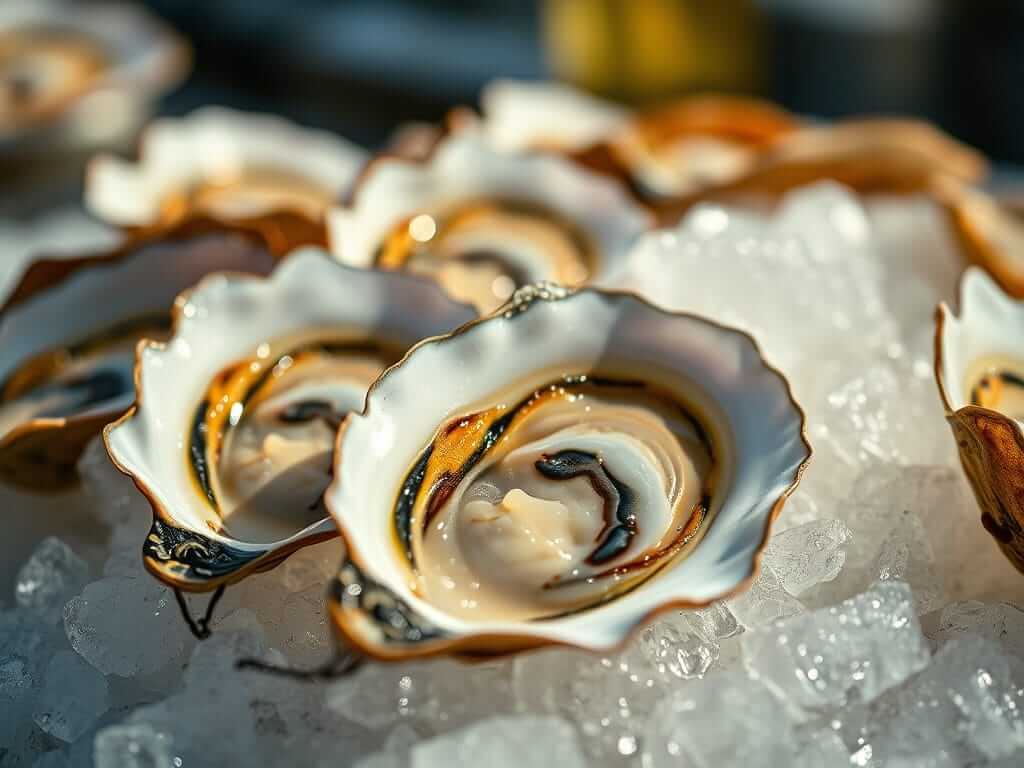
Oysters are the “unsung hero of the sea,” the “kidneys of the ocean,” “seabed engineers,” “tiny workhorses of the water.”[3] As heroic and uncomplaining as they are, bivalves have their limits. Too much harvesting for human dining tables, and even their prolific reproduction strategies can’t keep up. Too much pollutant load, and populations become sick. Too much heat, and they can’t tolerate the water temperature. Unfortunately, oyster populations around the world have been nearly wiped out by over-harvesting, pollution, disease, and climate stress. In the Chesapeake Bay, populations are thought to be one percent of what they were. Along UK coasts, maybe five percent.
Humans did this, and some humans are now trying to fix it. We realize now that oysters provide abundant benefits for ocean health, climate resilience, and coastal economies—people (not me) will pay good money to eat them. So we humans are doing everyone a big favor by restoring their populations. Ten US states have programs underway, collecting oyster shells from restaurants in New Jersey, for example, to be cleaned by volunteers and used as substrate for new reefs.[5] In the UK, one partnership has developed large, artificial oyster reef cubes made of eco-friendly concrete. The cube surfaces are textured to provide knobby protrusions and little pockets so that creatures can clamp on or hide, or both. A team of volunteers helped “seed” twenty cubes by sticking 4000 oysters on them. The cubes were then settled underwater off the Northeast coast of England. Nearby, workers strewed on the ocean floor 35,000 “spat-on-shell”—basically oyster babies on a half shell. Next season, the babies will breed like mad and have places nearby to cling and grow.[6]
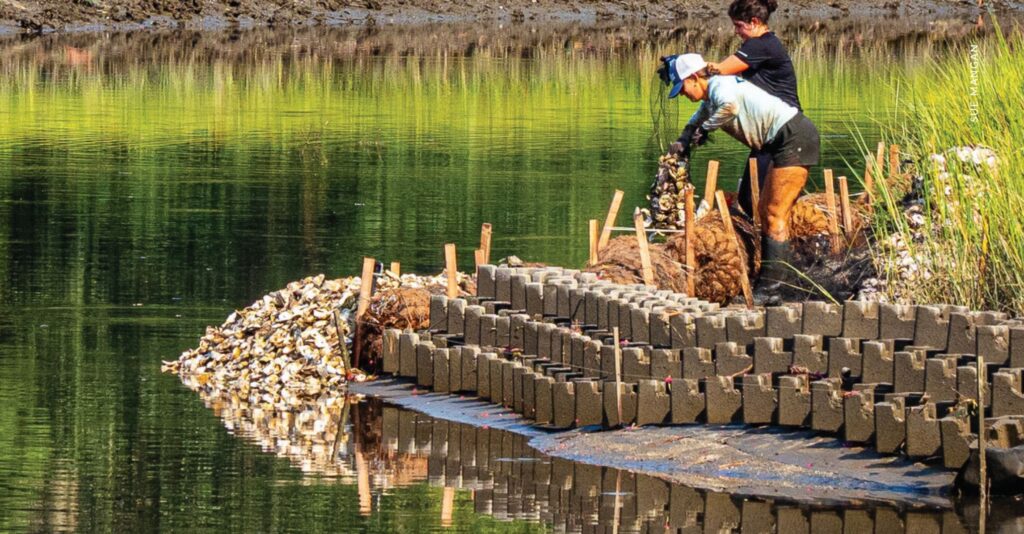
These are human-made refugia, helping to repair the destruction we have caused through ignorance or greed. Here as in so many instances, with a little strategic help, nature will meet us halfway and start to heal. These restoration projects are revealing that even with a small start, oysters respond quickly and eagerly, taking up again their helpful ecosystem work.
Here in Michigan, we do not have oysters, but we do have native freshwater mussels and clams—some of them endangered, too, thanks to pollution and habitat loss. We also have invasive mussels. Most of what we find washed up on Lake Michigan beaches now are millions of tiny zebra and quagga mussel shells, shoved by the waves onto the beach in scraggly lines of crunchy clumps, as if the lake is saying, “What’s all this?? What are you going to do about it?”
Native to Russia and Ukraine, zebras and quaggas arrived in the Great Lakes in the 1980s, likely in ballast water from ships via the St. Lawrence. Zebras and quaggas reproduce prolifically, outcompete native species, and over-filter the water, starving other creatures of life-giving plankton. Zebras and quaggas will gladly attach to anything—boats, docks, water intake pipes, and other mussels. They will cover native mussels and suffocate them.[7] These invasive mussels, in other words, do not help the ecosystem. They are greedy and destructive. To be fair, it’s not their fault. They’re just in the wrong place—and that’s our fault.
It’s easy to take the lives of these weird bivalves for granted. When they’re doing what they’re meant to do, in the right place, they gain strength by sticking together and clinging hard. They process pollutants so that other creatures don’t have to. They not only thrive themselves, but they protect and support whole ecosystems for their marine and human neighbors. As Father Pete Nunnally writes about oysters, “Oysters do not hide from the issues of the ecosystem, they are at the ground level of systemic change. That change doesn’t begin by emptying out all the water, or moving somewhere else, or refusing to take in the polluted water. Oysters do not avoid toxicity, they transform it.”[8] I wonder if communities of faith might learn a thing or two from oysters.
Once in a while, when I’m walking along the beach near our family’s cottage on the big lake, I’ll spot some glinting mother-of-pearl shell and pocket it, thinking about the humble creature that lived, died, dissolved, and left this work of art behind, a fragment churned and tossed and caressed by the lake until time and weather brought it to the shore. The shell will wind up on my desk, for no reason except so that I can admire it there and thumb its smooth surface when I need to fidget, admiring the play of light on the shell, like a satiny angel’s wing.
[1] Thanks to Father Pete Nunnally for sharing this metaphor with me and writing about it on his Substack.
[2] Fun fact: Oysters release “pseudo-feces”—mucus covered undigestible bits—before the digestible bits go through their digestion system, after which any remaining waste is released as actual feces.
[6] Sources and here and here.
[7] In North America, 65% or 300 species are vulnerable at least;
[8] Father Pete’s substack again.
Images credits: Featured image, workers doing oyster restoration, oysters on the half shell. Lake image is my own photo.

8 Responses
Oh, you are talking my language. I lived six years in West Sayville, Long Island, New York, the little Dutch town that was to oysters and clams what Escanaba is to smelt. The Great South Bay, on which I worked for five summers, was a nursery for oysters, the home of the “Blue Points,” and then as the water warmed became the great source for hard shell clams. And now over-population has so polluted the waters that the clams, while still numerous, are inedible, and a whole way of life is gone. West Sayville had streets paved with broken clamshells. And now the water in Peconic Bay is getting too warm for bay scallops. The slow recovery of these bivalves is precious to me.
They farm exquisite oysters further east off the North Fork in Gardiners Bay, maybe some of the best I’ve had. It is terribly sad about the pollution in the Great South Bay (although the sharks don’t seem to mind) and the Peconic.
Thank you and amen. Perhaps one of my favourite pieces about one of my favourite creatures! (Although your personal aversion to eating oysters came through loudly. Twice. They are incredibly delicious too!) I really appreciated the overall connection to other bivalves. Eastern North America has a huge freshwater diversity of them, particularly in the South. I’ll have to read up Father Pete. Thanks again!
Yes, Father Pete is great, and has a new book out with Broadleaf called “Catching Grace.” It’s a lovely spiritual memoir with a LOT of stories about fishing. (He’s an avid angler.) Also: sorry about my anti-oyster culinary prejudices. I just think the texture is kinda icky. Maybe I’ll change my mind someday!
Try them oven baked..Oysters Rockefeller.
Thank you for this thoughtful reflection. I appreciate the emphasis on compassion, community, and the practical ways faith can shape our daily lives. It’s encouraging to see conversations that inspire people to care for others with kindness and generosity rather than simply discussing ideas in the abstract.
Our team at Barakah in Kindness (https://barakahinkindness.org.uk/) is passionate about supporting communities through acts of kindness, charitable outreach, and practical assistance, so this message resonated strongly with us. The reminder that small acts of service can have a meaningful impact is one that never grows old.
Thank you for sharing your insights and for encouraging readers to live out their faith through action.
I love your meditation on oysters. Lots for us humans to admire and to learn from their behaviour. But they are also incredibly delicious! I hope you can add their taste to your vocabulary of tastes someday! Fortunately for me in the Midwest they are expensive enough that I can’t over-indulge.
Thanks for this interesting bivalves lesson that diminished my ignorance of these valuable creatures a bit.
And two of the responses made me wonder whether I should boldly – but oh so hesitantly – take a bite of that icky-looking oyster flesh….