
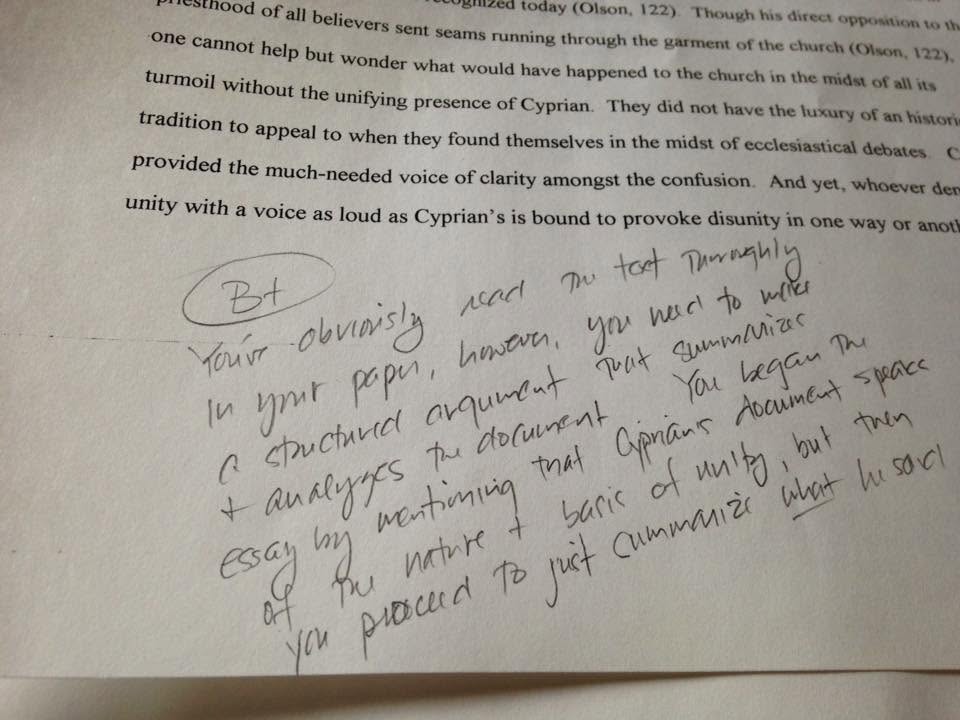
As a college and seminary student, I rarely spoke up in class. I nodded fiercely as professors taught and took copious notes, but I avoided raising my hand to contribute to discussions unless absolutely necessary. In my research papers, I summarized and compared and contrasted without positing a thesis or making an argument. Why? Because I was afraid of being wrong.
When I eventually landed in the pulpit, my fear of being wrong came right along with me.
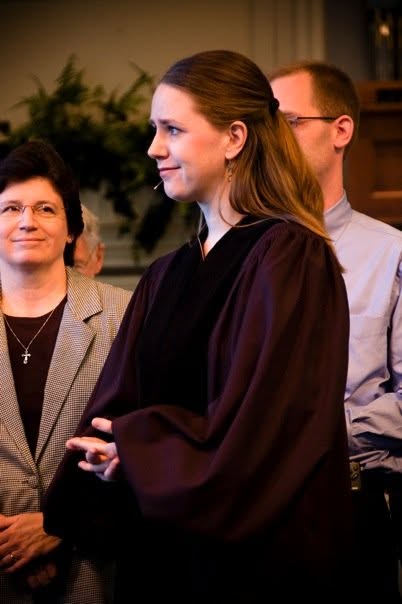
Photo Credit: Christian Bell
I dutifully backed up my sermon points with quotes from Reformed theologians and philosophers (and my pastor-dad). That way, if a parishioner had a problem with something I’d said, they could go ahead and take it up with someone smarter than me (and those someones, especially in my early years of preaching, were usually dead or old [sorry, Dad!] white men).
My fear of being wrong or being perceived as incompetent also kept me from navigating conflict well. Instead of talking to the people I disagreed with, I talked about them with people I knew agreed with me.
This way of being in the world worked for me. Until it didn’t.
In my late-thirties, with the help of coaches and peers, I began to peel back the layers of my avoidant patterns. Underneath it all, I found the shape and size of my fear: the black hole of never knowing enough, the prickly blush of saying the wrong thing, the throbbing pulse of not being sure I belonged in the spaces I was occupying.
And it was right there that God met me with strength and peace and presence. The text of Scripture that anchored me during this time (and ever since) was Isaiah 51:16: “I have placed my words in your mouth and covered you with the shadow of my hand.”
My reflections on this verse led me to articulate a commitment to a different way of being in the world – “I will join the conversation as the Spirit leads, respecting others and receiving their respect for me.” Insofar as I have found the strength to honor this commitment, I have grown in confidence and connection, finding and using my voice in the pulpit, in the council room, and in challenging relationships.
A few weeks ago, I heard echoes of Isaiah 51 and my mid-life commitment when I came across what would become one of my favorite lines from Richard Rohr’s The Universal Christ. Rohr says that when you embrace the mystery of Christ, “it will feel like a calm and humble ability to quietly trust yourself and trust God at the same time” (p. 87). Yes.
Forgive me for saturating this post with footnotes (it is kind of what I do!), but I also recently read Brené Brown’s latest book, Strong Ground, where she talks about ‘humble ability.’ Humility, she writes, “involves understanding our contributions in context, in relation to both the contributions of others and our own place in the universe.”
In other words – in my words! – people in my communities of practice and life have strong and important things to say. I also have strong and important things to say. And together we humbly offer our contributions in a world where God can be trusted to place words and to cover with shadows.
Brené Brown sometimes defines humility with this sentence: I’m not here to be right, I’m here to get it right.
I’m here to get it right. Or, even better, we’re here in the midst of the mess of this world to get it right. We’re here to Get Right the work of justice and shalom. And in order to Get the work Right, we will need to join the conversation as the Spirit leads, sometimes agreeing and sometimes disagreeing, but always finding ways to trust God and to treat each other with dignity and respect.
As we work to get it right, you know what? Sometimes we’re actually going to be wrong and sometimes (gasp) we’re going to get it wrong.
One of the invitations I received when I was beginning to comb through my patterns of conflict avoidance was to ask people I trusted two questions: What can you almost always count on me for? And what can you almost never count on me for? Oh, boy. Sometimes I get it wrong. In predictable and consistent ways.
The very thing I’ve been so afraid of all my life – being wrong – happens. Has happened. Will happen. But, in a sense, being wrong and getting it wrong are nothing to be afraid of. Because when it happens, I have a way to move forward. We have a way.
Out beyond ideas of wrongdoing and right doing, there is a field where we can meet each other with love.
A few days ago, I listened to a conversation between three women: Kate Bowler, Nadia Bolz-Weber, and Sarah Bessey. They were talking about why, in the midst of the mess of the world, they are still Christians. Sarah relayed something toward the end of the conversation that one of her teenagers had said to her. “Even if [Christianity] all turns out to be garbage, I love this way of moving through the world. I love going through life with the belief that the world is loved, that all of us are loved.”
This is the way of being that inspires me now. As the Spirit leads, I join conversations – sometimes without fear and sometimes with it. Sometimes confessing. Sometimes forgiving. Always learning and growing. I join conversations and communities, movements and messes, with beloved people as a beloved person. Beloved by myself, beloved by People of Peace, beloved by God.

12 Responses
I love this, Heidi. Grace received and given. Belovedness. Thanks for sharing.
Thank you for your beautiful testament to your growth from conflict avoidance into emotional self-awareness. There’s nothing more important in personal growth and for leaders to model to others. There was a song in the 1970s, “cruel to be kind” that describes the toxic side effects of conflict avoidance. Thank you for modeling something that’s authentic. You certainly will gain the trust of others in all your relationships.
Oh, THIS. To lean on another wise voice: thank you, thank you, thank you; help me, help me, help me; and wow, wow, wow (Lamott).
And I also loved that podcast with Bessey, Bolz-Weber, and Bowler!
Yes, ma’am. Your path of growth resonates with me, a fellow “recovering perfectionist,” as I put it. God meets us where we finally accept our inadequacies and eventually learn to love our whole selves. Because we are eternally beloved, in every sense of both words. Beloved, beloved, beloved. And then we can converse and preach and meet others with such freedom, because every single one of us is beloved. Thanks for this uplifting piece today.
So very good to read and let percolate. It made me think about Eugene Peterson’s musings on the “middle voice” and a very different, more engaging way of living: not the either-or of active and passive but two subjects who together produce and share in results. A together way. Thanks for taking us along your journey!
This spoke to me deeply. In this season away from pastoral ministry, I’m doing a lot of soul work to recover the parts of myself and my voice that I’ve lost for fear of not being right…according to the many different perspectives on what “right” is that you find in a given congregation. Yesterday my therapist and I worked through the imagery of an anchor, and the idea of being anchored in God, and thus anchored in myself, rather than relying on external voices or connections to provide that sense of grounding. “Trusting yourself and trusting God at the same time.” Yes. Thank you.
Heidi,
Thanks for your leadership and for outlining so courageously the pathway of your own spiritual growth. Meekness is not weakness!
The wisdom of Sarah Bessey’s daughter’s comment deserves a second look. In the midst of all our inadequacies, doubts, and church blunders stands Jesus as the way things were intended to be – wise, powerful, and “right,” yet gentle, self-sacrificing, and infinitely gracious. What a way to live and to ” move through the world.”
I have taken on the practice of gently asking my agnostic and Jewish friends a question: Let us suppose for a moment that Jesus of Nazareth was not who he claimed to be. But if you could design a God or a Messiah that you could believe in, would she or he not resemble Jesus? We might not be as far apart as we think.
This touches very close to me.
Your picture of the light at the end of the Tunnel Park tunnel is a good metaphor for your account of learning how to move through the world.
Thank you.
Thank you once again, Heidi. It strikes me that good things really happen when self judgment, as well as fear of being judged as wrong subsides. I often see how judgment always stops learning. And also, how self judgment hinders, self appreciation and thankfulness for the gifts that God has given us. And God has given you some pretty good ones!
Wonderful! For me I call it humble courage.
Thank you for this encouraging reflection. It takes courage to speak up.